

Table of Contents
An AI media buyer is software that connects to your ad accounts and does the daily work of a media buyer: it reads the numbers, moves budget toward the ads that sell, pauses the ones that lose money, refreshes tired creative and reports back, inside spending limits you set. For a small or mid-size account it can take over most of that routine work for a monthly software fee, where a person costs a salary or, at an agency, often 10 to 20% of your ad spend. Your offer, your strategy and the big spending decisions should still stay with a person.
This guide compares an AI media buyer with a freelancer, an agency and an in-house hire on cost, speed, control and risk, sets out what to hand over and what to keep, and reviews the 8 tools that come up most when people search for one, starting with CamClo AI's Ad Autopilot AI media buyer for Meta and Google Ads.
We checked every price on the vendor's own site. Here is how we compared them.
What an AI media buyer does
A media buyer's job has two halves. Planning is choosing the offer, audience, channels, budget and creative angles. Operating is launching campaigns, checking results daily, shifting budget to winners, pausing losers, replacing worn-out ads and reporting. Today's AI media buyers are strongest at operating. Most can draft a plan too, but they build it from what you tell them about your business.
Under the hood, most of them run the same loop:
- Read. It pulls spend, results, cost per result and frequency from your ad accounts through the platforms' APIs.
- Decide. It compares the numbers with your targets and picks the next move: raise a budget, pause an ad, test a new creative.
- Check. A well-built one tests every move against hard limits before anything changes.
- Act or ask, then log. Depending on the mode you choose, it makes the change or sends it to you for approval, and records what it did and why.
"AI media buying" covers four different things:
- Built-in platform automation, such as Meta Advantage+ and Google Performance Max, which works inside one platform.
- Rules tools that run "if this, then that" instructions you write. Our guide to Facebook ads automation covers these.
- AI agents that read the whole account, decide, and then act or ask. This is what most people mean by an AI media buyer, and what this guide compares. For agents that also write content or run SEO, see AI marketing agents.
- Do-it-yourself agents built with Claude Code or n8n on the ad platforms' APIs.
AI vs human media buyer: cost, speed, control and risk
| AI media buyer | Freelancer | Agency | In-house hire | |
|---|---|---|---|---|
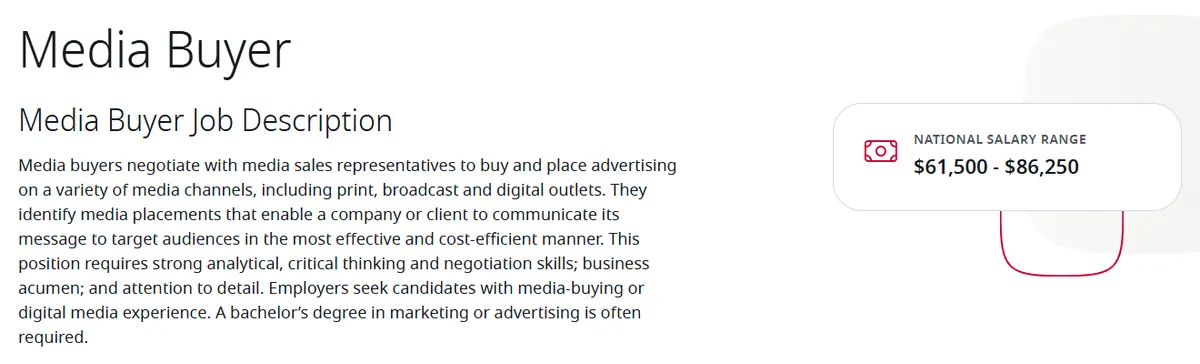
| Cost | From $45 to $100 a month for the self-serve tools here, rising with spend or usage, plus ad spend | Hourly or a monthly retainer; quotes vary widely | Often 10 to 20% of ad spend, frequently with a minimum fee | $61,500 to $86,250 a year in US salary, plus benefits |
| Hours | Checks every campaign around the clock | Their working hours | Business hours, through an account team | Your working hours |
| Time to start | Same day, once tracking works | Time to find, vet and brief someone | Proposal, contract and onboarding | Recruiting and onboarding |
| Control | Hard caps and approval modes you set; a log of every change | Depends on the person and your agreement | Reports and calls on the agency's schedule | Direct, day to day |
| Judgment | Works from your goals and data; weak on offer and positioning | Strong, if experienced | Strong, with specialists | Strong, and learns your business |
| Main risk | Acts quickly on bad data, such as broken tracking | One person, one point of failure | Fees rise with your spend on percentage deals | A fixed cost whatever the results |
Salary: Robert Half's 2026 national range. Agency fees: OuterBox's 2026 PPC pricing guide, which says percentage deals "commonly land around 10% to 20% of monthly media spend, often with a minimum management fee". Tool prices: vendor pricing pages.
A worked example at $15,000 a month in ad spend
- Agency: 10 to 20% of spend is $1,500 to $3,000 a month. OuterBox says many PPC management engagements fall between $1,500 and $5,000 a month.
- In-house hire: about $5,125 to $7,190 a month in salary alone, from Robert Half's range divided by 12.
- AI media buyer: Creatify Pro is $99 and Mindra Pro is $100 a month. Madgicx is $229 a month at $10,000 to $20,000 of monthly spend. AdAmigo.ai's full plan is $349 per ad account, since its $99 plan is meant for accounts spending under $2,000 a month. On CamClo AI, one campaign on the monthly agent rate uses 80 of the 150 credits in the $49 plan.
The software is far cheaper, but someone still has to set the targets, approve the big moves and read the weekly log, so budget some of a person's time each week too.
What marketers trust AI with today
In a Digiday survey of more than 100 marketers, reported by AdExchanger in June 2026, two thirds of those using AI for social campaigns used it for data analysis and 57% for content creation, but only 32% let it buy ad placements, because the marketer is on the hook if it buys badly. That is why the guardrails matter more than the demo.
What to hand over and what to keep
Hand over to the AI
- Daily checks of spend, results and delivery
- Pausing ads that clearly lose money
- Small budget steps toward winners, inside your caps
- Spotting ad fatigue and drafting fresh creative
- Search-term clean-up and negative keywords
- Alerts on spend spikes, zero delivery and broken tracking
- Weekly and monthly reports
Keep with a person
- The offer, pricing and positioning
- The total budget and the caps the AI works within
- New markets, new audiences and bid strategy changes
- Final approval of creative that carries your brand
- Admin access to ad accounts and payment methods
- Special ad categories such as housing, employment and credit
- The decision to stop a campaign for good
The rule of thumb: hand over what is frequent, measurable and easy to reverse, and keep what is rare, strategic or hard to undo. Creative sits in between. Ads wear out as the same people see them again, so a media buyer that can make a fresh ad saves a round trip to a designer. Our pieces on curing Meta ad fatigue and on ad creative explain what a good replacement looks like.
How to switch from manual to AI media buying
- Fix tracking first. An AI media buyer optimizes toward whatever it is told is a conversion, so make sure purchases or leads report correctly.
- Write down your limits. A daily cap, a monthly cap, the most you will spend testing something unproven, and a target cost per result or return on ad spend.
- Start in recommend-only mode. Compare its calls with your own, or your current buyer's, for a week or two.
- Move to approvals. Approve each change from your inbox, and notice which kinds you approve every time.
- Automate the routine. Let those moves run on their own, such as small budget steps and pausing clear losers, and keep new audiences, new markets and bid changes on approval.
- Keep a weekly review and an off switch. Read the log, check results against your own sales data, and make sure one click stops the agent without stopping your ads.
In Ad Autopilot, steps 3 to 5 are its Observe, Co-pilot and Autopilot modes. See how the Ad Autopilot modes and spend caps work.
Quick picks
Plans, launches and manages campaigns, and makes fresh ads when old ones wear out.
AI Media Buyer sits next to AI actor video ads on the $99 Pro plan.
Meta and Google, review first or auto-apply, from $99 per account.
Seven ad platforms including LinkedIn and TikTok, with AppsFlyer and Adjust attribution.
Element-level creative tagging, with autonomous agents on its top tier.
Search, social and programmatic for large budgets, priced on request.
The platforms' own automation, with no separate fee.
AI media buyers compared
| Tool | Best for | Channels | Paid plans from | Acts on its own? | Free option |
|---|---|---|---|---|---|
| CamClo AI | Meta and Google ads with creative in the same loop | Meta; Google Ads (pilot) | $49/mo | Your choice: Observe, Co-pilot or Autopilot | 7-day free trial, 20 credits (card required) |
| Creatify | Video ad creative plus buying | Meta, TikTok, AppLovin; Google Ads per its launch post | $99/mo (Pro) | Acts within goals and guardrails you set | Free plan, 10 credits a month; agent listed from Pro |
| AdAmigo.ai | A fixed price per ad account | Meta, Google Ads | $99/mo per ad account | Review first, or auto-apply | 7-day free trial |
| Madgicx | Small Meta-only budgets | Meta | $45/mo under $1K ad spend | Prepares actions; you click Launch | 7-day free trial |
| Mindra | Many channels and app installs | Google, Meta, TikTok, LinkedIn, Reddit, Snapchat, X | $100/mo (Pro) | Asks first; low-risk moves can run alone | 5 days or 3,125 credits (card required) |
| Hawky | Creative analytics plus agents | Meta, Google, TikTok | Talk to sales | Yes, on the Auto-pilot tier | Walkthrough on your account |
| Albert | Enterprise, cross-channel | Google, Bing, Meta, YouTube, TikTok, DV360 | Custom | Self-optimizing campaigns | None listed |
| Advantage+ / PMax | A free base layer | Their own platform only | No separate fee | Yes, inside a campaign | Included |
Entry paid plan that includes the media buying agent, on each vendor's official site, in US dollars, billed monthly. Ad spend is always extra and is billed by the ad platform. "Talk to sales" and "Custom" mean the vendor does not publish a price. Confirm before you buy.
The tools, one by one
Each entry covers what the tool does, what it costs, how much it does on its own, and when you should pick it instead of CamClo AI.
1. CamClo AI (Ad Autopilot)
Best for: Meta and Google ads with the creative made in the same placeAd Autopilot is the AI media buyer inside CamClo AI's ad studio. You give it your website and the result you want. It researches the business, drafts a campaign plan you review, prepares the ads and copy, and by default publishes the campaign paused, so nothing spends until you switch it on. After launch it reviews each campaign on a daily schedule, watches for problems in between, and proposes or makes the next move within your limits.
- Platforms: Meta (Facebook and Instagram), including retargeting, lead-form campaigns and expansion into new countries with localized ads. Google Ads (Search, Performance Max and Demand Gen) is open to accounts in the Google pilot.
- Three modes: Observe only recommends. Co-pilot, the default, sends each change for your approval in the app or from the email. Autopilot makes routine changes itself and still sends high-impact ones to you. You can pin any type of action to "always ask" and set quiet hours.
- Guardrails enforced in code: it never raises a budget past your daily or monthly cap, and reaching the monthly cap pauses the campaigns it manages; budget raises of 20% or less, at least a day apart and only after three settled days on target; new ad sets, targeting, new countries, bid strategy and pausing a whole campaign always wait for you; it pauses but never deletes; stop-loss rules stored in your Meta ad account catch runaway spend even if CamClo is down; and one switch stops the agent on a campaign or the whole account.
- Between reviews: checks for spend anomalies, zero delivery, cost spikes and broken tracking, and a loss stop, on by default, pauses a campaign after three settled days in a row at twice your target cost per result or worse.
- Creative and reports: when an ad wears out, it makes a fresh image or video version from the one you started with (a new image costs 1 credit). For Meta campaigns you can ask questions in chat, set standing rules such as never touching a named ad, and request reports.
- Pricing: plans from $49 per month with 150 credits. The agent costs 80 credits per campaign per 30 days, or 3 credits per day it works on pay as you go, with quiet days free. It is never a percentage of ad spend, which Meta and Google bill to you directly. There is a 7-day free trial with 20 credits. On the trial, each completed agent review costs 6 credits.
- Availability: in beta; you request access in the app.
Strengths
- Buying and creative in one loop, so a tired ad gets a fresh one without a designer
- Limits enforced in code, not left to the model's judgment
- Flat credit pricing, so it has no reason to push your spend up
Limits
- Can seem a little expensive next to a simple rules tool, but the credits cover the campaign plan, the fresh creatives and the daily management, not just a set of rules
To see the plan, the decision trail and the guardrails in action, visit the Ad Autopilot product page. The creative side runs on the same studio as our AI image ad generator.
2. Creatify
Best for: video ad creative and media buying under one planCreatify is an AI ad platform best known for video ads with AI actors. In June 2026 it launched AI Media Buyer, an agent that connects to your ad accounts, audits your spend, builds campaigns and creative, launches them and keeps optimizing, all from a chat interface. Creatify says the agent acts on the optimizations it recommends, while you set the goals and guardrails and approve the direction.
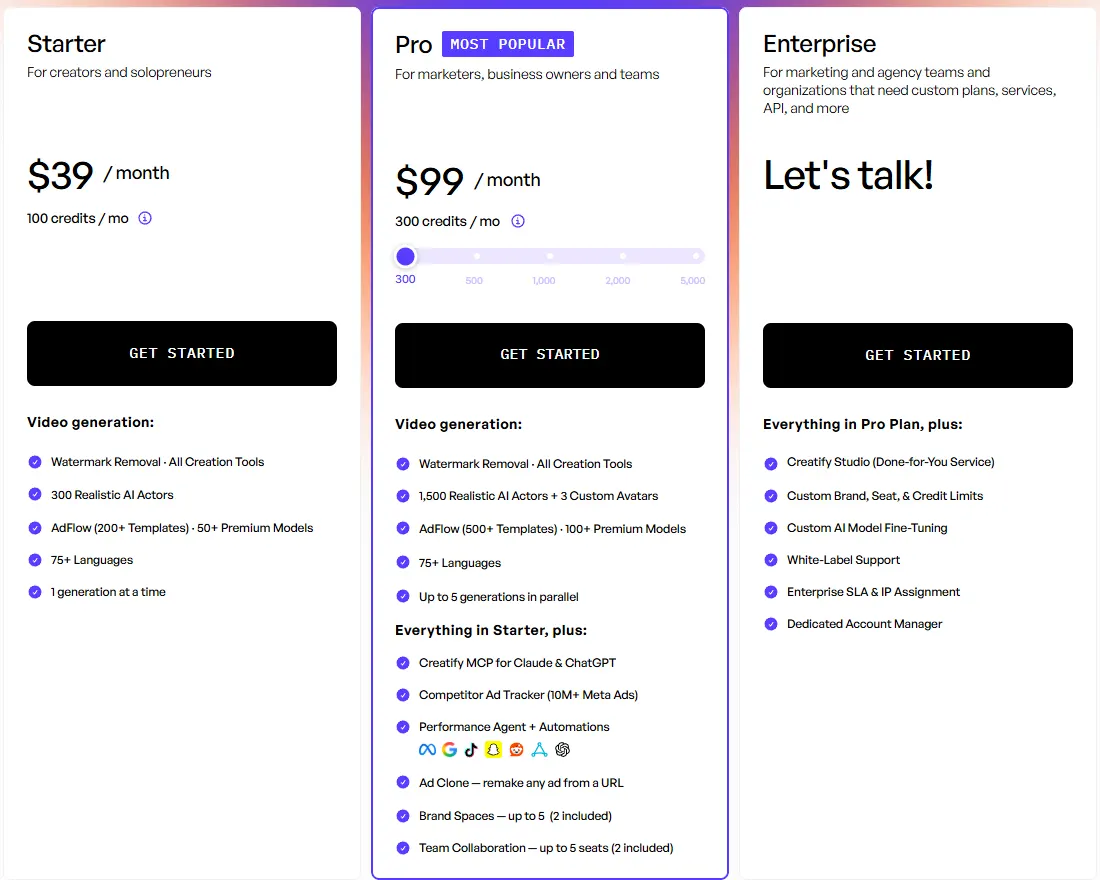
- Pricing: the Performance Agent comes with Pro, $99 per month with 300 credits, with larger credit tiers up to 5,000. Starter, at $39, does not include it. Creatify says annual billing saves up to 50%.
- Channels: the plan comparison table lists Meta, TikTok and AppLovin for the agent; Creatify's launch post also names Google Ads.
- Free: 10 credits a month with watermarked exports. The pricing page lists the Performance Agent from Pro up, though the launch post says you can connect an account and try it without a credit card.
Strengths
- AI actor video ads and the buying agent in one plan
- Chat-first; Creatify says a brief can become a live campaign in under 60 seconds
Limits
- The agent needs the $99 Pro plan
- The pricing page and the launch post list different channels, so confirm yours
Pick this instead of CamClo AI if your ads are mostly AI actor videos and you buy on TikTok or AppLovin. For plan details, see our Creatify pricing breakdown.
3. AdAmigo.ai
Best for: a fixed monthly price per ad accountAdAmigo.ai describes itself as an AI media buyer that runs your ad accounts on Meta and Google. It learns your brand, goals and guardrails, then designs ads, launches campaigns and optimizes daily. You choose review first, where it prepares recommendations each morning and waits for your approval, or auto-apply, where it makes changes overnight.
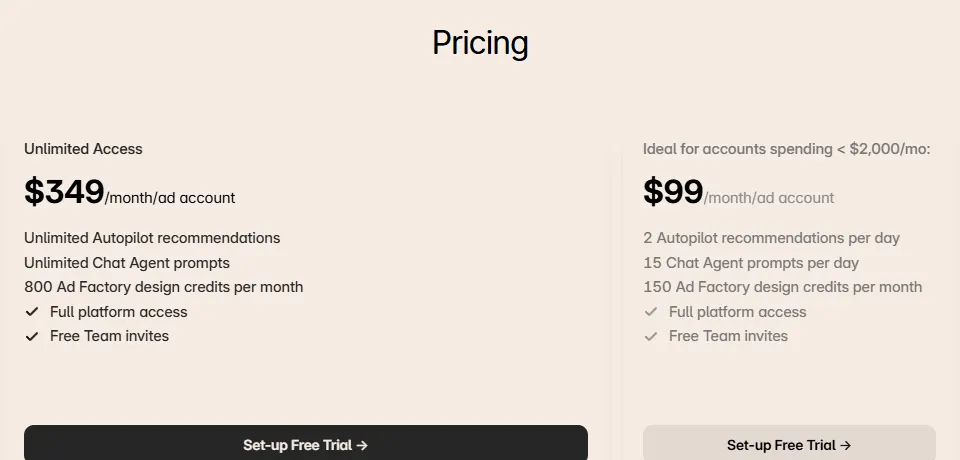
- Pricing: $99 per month per ad account for accounts spending under $2,000 a month, with 2 Autopilot recommendations and 15 chat prompts a day and 150 design credits a month. $349 per month per ad account for unlimited recommendations and prompts and 800 design credits. Agency pricing is on request.
- Channels: Meta and Google Ads. AdAmigo says TikTok support is planned for later in 2026.
- Free: a 7-day free trial with the chat agent, autopilot and ad creation.
Strengths
- A clear, published price per ad account
- Guardrails for budgets, targeting, goals and even naming conventions
Limits
- The $99 plan allows 2 Autopilot recommendations a day
- The price multiplies with each ad account you connect
Pick this instead of CamClo AI if you want a fixed per-account price and an agent that can apply changes overnight.
4. Madgicx
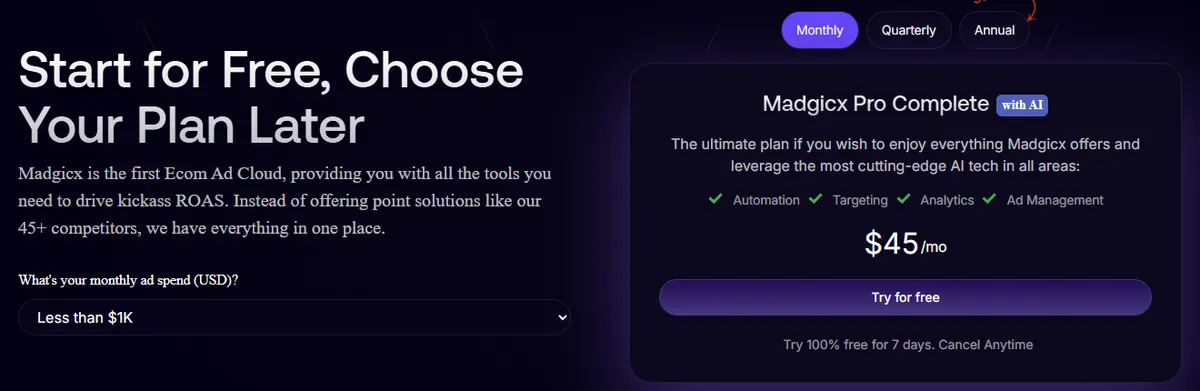
Best for: small Meta-only ecommerce budgetsMadgicx is a Meta ads platform for ecommerce, with automation, targeting, analytics and ad management in one plan. Its AI Marketer is a Meta ad agent that audits your account around the clock, prepares actions such as new ads and audiences, and waits for you to click Launch.
- Pricing (monthly billing): Pro Complete is $45 a month under $1,000 of monthly ad spend, $99 at $1,000 to $2,500, $119 at $2,500 to $5,000, $129 at $5,000 to $10,000, $229 at $10,000 to $20,000 and $329 at $20,000 to $30,000. The page marks annual billing as saving 30%. Tracking Pro is a $49 a month add-on.
- Free: a 7-day free trial.
Strengths
- The lowest entry price here for small accounts
- A broad Meta toolset in the same plan
Limits
- AI Marketer is for Meta only
- The price climbs with your ad spend
Pick this instead of CamClo AI if you only advertise on Meta, spend under a few thousand dollars a month, and want to approve every move with one click.
5. Mindra
Best for: many channels, including app installsMindra is an AI employee platform, and it bills its ads agent as "your AI media buyer, running 24/7". It connects Google, Meta, TikTok, LinkedIn, Reddit, Snapchat and X ads, attribution tools such as AppsFlyer and Adjust, and creative libraries in Drive or Dropbox, pulls results down to the ad and the region, and posts reports to Slack. Mindra says its agents never move budget silently: pausing, launching a test or pushing a new creative waits for one tap of approval, though you can let low-risk moves run on their own within guardrails.
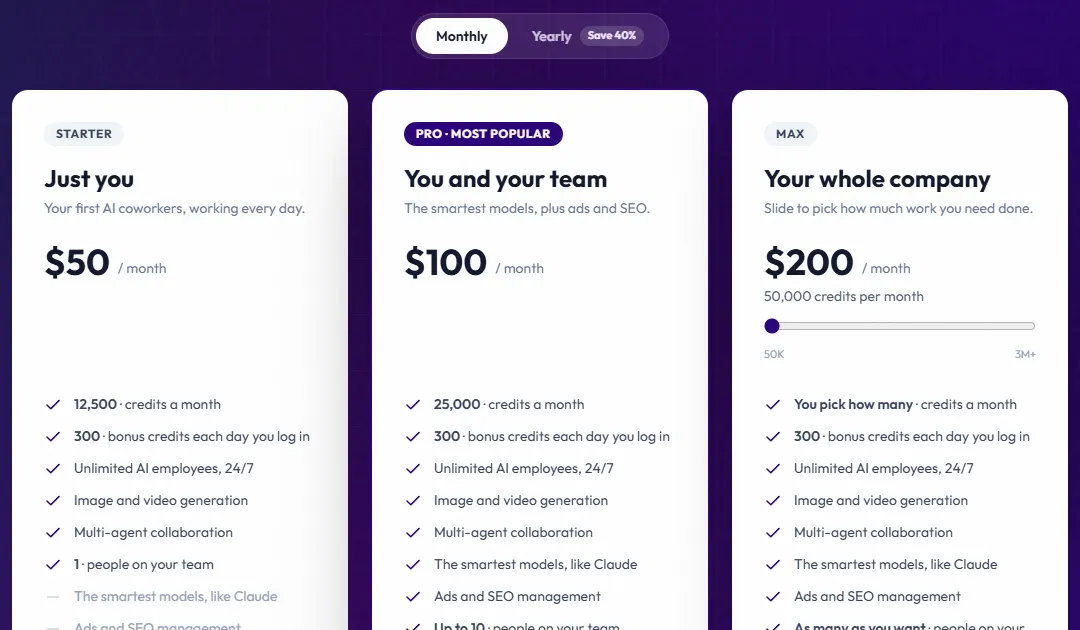
- Pricing: ads management starts on Pro, $100 per month with 25,000 credits and up to 10 people. Max starts at $200 per month. Starter, at $50, does not include ads management. Yearly billing saves 40%.
- Free: a trial of up to 5 days or 3,125 credits, with a card required.
Strengths
- Wide channel list, including LinkedIn, with app-install attribution
- One-tap approvals with the reasoning shown
Limits
- Ads management starts on the $100 Pro plan
- Credits are shared with every other AI employee on the plan
Pick this instead of CamClo AI if you advertise an app or on LinkedIn and TikTok, and you want the same agent team to handle other work such as SEO.
6. Hawky
Best for: creative analytics plus autonomous agentsHawky is an agentic performance marketing platform for Meta, Google and TikTok ads. Its lower tiers are dashboards and a plain-language copilot. The top tier, Auto-pilot, adds autonomous agents: a Performance Agent for bids, budgets, goals and rebalancing between channels, a Creative Agent, and anomaly detection that pauses things automatically.
- Pricing: every tier is "Talk to sales", and Hawky says pricing is per brand and scales with use. All tiers include unlimited users.
- Free: none listed; Hawky offers to show the product on your own account first.
Strengths
- Tags every hook, frame and call to action in your ads
- Competitor tracking and no per-seat fees
Limits
- No public prices
- The autonomous agents are only on the top tier
Pick this instead of CamClo AI if your team wants deep creative analytics across Meta, Google and TikTok and is happy to go through a sales call.
7. Albert
Best for: large, cross-channel budgetsAlbert is an AI marketing platform that runs self-optimizing campaigns across search, social and programmatic, which it says covers "90% of the biddable universe": Google, Bing, Facebook, Instagram, YouTube, TikTok and DV360. It presents itself as a partnership between people and AI rather than a replacement for marketers.
- Pricing: custom. The estimate form on its pricing page starts at yearly ad budgets of $100,000 to $500,000.
- Free: none listed.
Strengths
- Covers programmatic as well as search and social
- Built for enterprise advertisers and agencies
Limits
- No public price
- Sized for six-figure yearly ad budgets and up
Pick this instead of CamClo AI if you run large budgets across search, social and programmatic display and want one enterprise vendor for all of it.
8. Meta Advantage+ and Google Performance Max
Best for: a free first layer of automationBefore paying for anything, use what the platforms already include. Meta says its "most advanced AI optimizations are enabled when your sales campaign uses Advantage+ audience, placement and budget", and that advertisers who used Advantage+ sales campaigns saw a 9% improvement in cost per conversion on average. Google's Performance Max reaches all Google Ads inventory, including YouTube, Display, Search, Discover, Gmail and Maps, from one campaign, and moves budget toward the best-performing inventory automatically. If most of your spend is on Google, our guide to Google Ads AI agents goes deeper.
- Pricing: no separate fee; you pay only for the ads you run in Meta Ads Manager or Google Ads.
Strengths
- No separate fee, and each platform's own signals
- An AI media buyer can manage them from one level up
Limits
- Each works inside one platform, so nothing moves budget between Meta and Google
- You still decide what to launch, how much to spend and when to stop
Pick this instead of CamClo AI if you run one or two campaigns on one platform and have time to check them yourself each week.
Or build your own AI media buyer
Some teams build their own. A write-up from Stratega describes a Claude Code agent that reads Meta Ads and GA4 data each week, flags ads to pause or scale against written rules, and never spends money on its own. The author reports that the weekly review went from 2 to 3 hours to 10 to 15 minutes, a self-reported figure. Others wire the same loop in n8n.
It costs little beyond your time and model usage, and you control every rule. The trade-off is that you also own the API access, token renewal, error handling and every guardrail, and a bug in a script that can change budgets is a bug that spends money. Stratega's agent, for one, stops at recommendations and leaves every change to a person.
How we compared them
We pulled the current Google results for "ai media buyer", "ai media buying" and "ai media buying platform" and reviewed the tools that appear in them and in the ranking roundups. We read each vendor's own pricing, product and help pages, saved screenshots, and recorded the channels, the entry price in US dollars for the plan that includes the buying agent, whether the tool acts on its own or asks first, and the trial. Madgicx prices by ad spend, so we read each tier from its pricing page. Salaries come from Robert Half's 2026 salary guide and agency fees from OuterBox's 2026 PPC pricing guide.
We did not run a performance benchmark, so there are no results claims here. Results depend on your offer, tracking, creative and budget, so test on one campaign before you hand over the account.
Frequently asked questions
What is an AI media buyer?
An AI media buyer is software that connects to your ad accounts and does the routine work of a media buyer: it reads performance, moves budget toward what works, pauses what loses money, refreshes tired ads and reports what it did. Good ones work inside spending caps you set and let you choose whether each change waits for your approval.
Can AI replace a human media buyer?
For the day-to-day operating work on Meta and Google, largely yes: monitoring, budget steps, pausing losers, creative rotation and reporting. It does not replace judgment about your offer, pricing, positioning and which markets to enter. Many brands let an AI media buyer run the routine work and keep a person, in-house or freelance, for strategy and a weekly review.
How much does an AI media buyer cost?
The self-serve tools in this guide start between $45 and $100 a month before ad spend: Madgicx from $45 (under $1,000 of monthly spend), CamClo AI from $49, AdAmigo.ai from $99 per ad account, Creatify Pro at $99 and Mindra Pro at $100. Hawky and Albert quote on request. Agencies often charge 10 to 20% of ad spend, and Robert Half puts a US media buyer's 2026 salary at $61,500 to $86,250.
Is it safe to let AI control my ad budget?
It is as safe as the limits around it. Check that the tool enforces daily and monthly caps, limits each budget raise, asks before big moves such as new audiences or countries, pauses rather than deletes, and has one switch that stops it. Start in a recommend-only or approval mode, and fix your conversion tracking first, because it acts on whatever numbers it is given.
How much does a media buyer make?
Robert Half's 2026 salary guide gives a US national range of $61,500 to $86,250 for a media buyer, with $71,000 for a candidate with moderate experience. Benefits, payroll taxes and tools come on top of salary.
Are Meta Advantage+ and Google Performance Max AI media buyers?
Partly. They automate targeting, placements, bidding and budget inside a campaign on their own platform, and they come with the ad platform at no separate fee. They do not move budget between Meta and Google, and you still decide what to launch, how much to spend and when to stop. An AI media buyer works one level up, managing those campaigns across the account.
Ready to hand over the daily ad work?
Try CamClo AI free for 7 days with 20 credits.
See plans and the free trial