


Table of Contents
An AI marketing agent is software that works toward a marketing goal on its own: it reads your data, decides the next step and takes it, such as launching a campaign, moving budget or pausing a weak ad, instead of only answering questions. The ones worth trusting with an ad budget act inside limits you set, such as spend caps and approval for big changes. For paid ads on Meta and Google, the main options are an agent that runs campaigns on both, such as CamClo AI's Ad Autopilot, the platforms' own built-in AI, and narrower agents tied to one store builder or one task.
We checked every tool on its official product, pricing and help pages. Here is how we checked.
What an AI marketing agent is
"Agent" is now stuck on almost every marketing tool, so a simple test helps: does it take actions toward a goal, or does it only suggest? Three kinds of software get called agents:
| Type | What it does | Example in paid ads |
|---|---|---|
| AI assistant | Answers questions and drafts content when you ask | "Why did my cost per purchase rise this week?" |
| Rule-based automation | Runs if-then rules you wrote, and nothing else | "Pause any ad that spends $50 without a sale" |
| AI agent | Works toward a goal: reads results, decides the next step, acts, then checks what happened | Given a sales goal, it shifts budget to the stronger ad set, pauses a tired ad and makes a fresh one |
Most products sit between the last two rows. Many recommend a change and wait for you to approve it: that is how Google's Ask Advisor and Amazon Ads Agent work. A few can also act on their own, inside limits you set, and let you choose how much they do alone.
What an AI marketing agent can do for paid ads
- Plan: read your website, products and account history, then propose an objective, audience, creative angles and budget.
- Make and launch: write the copy, generate image or video ads (some agents only use creative you upload), and build the campaign on the platform.
- Watch and adjust: check results through the day, move budget toward what works, pause what does not, and add negative keywords on search.
- Refresh and explain: replace tired creative before results fall off, answer questions about the numbers and write reports.
What no agent can do: fix an offer people do not want, see sales your tracking does not record, or promise a return. An agent optimizes toward whatever your pixel or conversion tag reports, so if purchases are missing or counted twice, it will chase the wrong result. Check tracking before you hand anything over.
What an AI marketing agent should never do on its own
Handing software your ad budget is the real decision. Before you connect an account, check that these controls exist and that the software enforces them, rather than leaving them to the AI's judgment:
- Hard spend caps. A daily and a monthly limit the agent cannot pass, whatever it concludes.
- Small budget steps. Big jumps can throw a campaign back into the platform's learning phase.
- Approval for big moves. New spend, new audiences, new countries and stopping a whole campaign should wait for you.
- Pause, never delete. A pause can be undone. A deleted campaign and its history cannot.
- Enough evidence first. One bad day is noise, and platforms keep attributing sales for days after a click.
- A backstop and a kill switch. Something that stops runaway spend even if the agent itself is down, and one control that stops the agent everywhere.
- A receipt for every action. What it changed, when, and why, in plain language.
- Pricing that does not grow with your spend. An agent paid a share of ad spend has a reason to spend more.
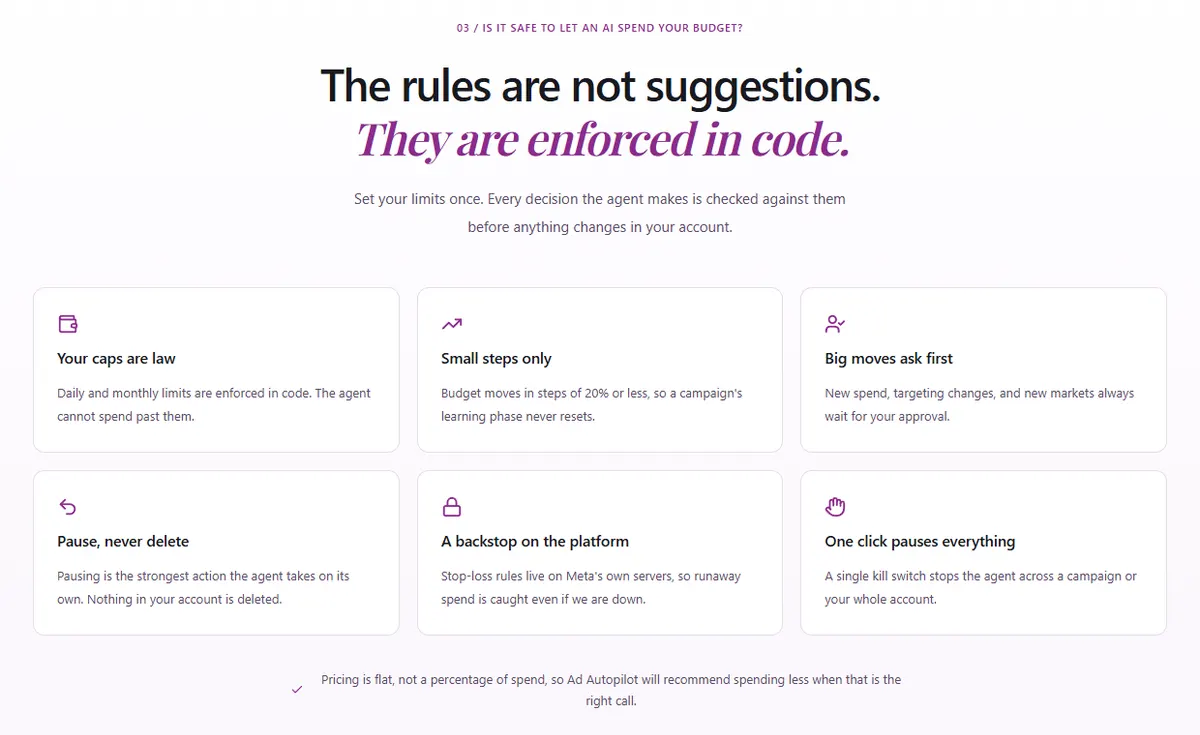
As an example of what "enforced" looks like, in CamClo AI's Ad Autopilot a budget raise is limited to 20% per step, and to $500 a day per step. Any budget change of $200 a day or more waits for your approval, even in its most autonomous mode. On Meta, an ad is only paused after at least 2,000 impressions, 48 hours and spend of 1.5 times your target cost per result, and never if it is still converting or is the last ad running. The dollar figures are converted for accounts in other currencies.
Platform AI or an independent agent
Meta and Google both build AI into their ad tools with no separate fee listed, and they see the most data about their own auctions. If you advertise on one platform only, start there. An independent agent earns its place when you run both Meta and Google and want one set of limits, one approval inbox and one report, when you want creative made and refreshed in the same loop as the buying, or when you want the agent paid in a way that does not rise with your spend. The two can work together, with Advantage+ or Performance Max inside the campaign and an agent on top. For platform detail, see our guides to Facebook ads automation and AI agents for Google Ads.
The kinds of AI marketing agents
| Kind | What it works on | Examples |
|---|---|---|
| Paid ads agents | Launching and managing ad campaigns | CamClo AI Ad Autopilot, Amazon Ads Agent, Meta's and Google's built-in assistants |
| Store and site agents | SEO, email, social and first ad campaigns for one platform's users | AI Marketing Agent for Shopify (Enrich Labs), Wix AI Marketing Agent |
| Ad creative agents | Making ads in volume, sometimes launching them too | Creatify |
| CRM and lifecycle agents | Messages to your customer list, customer data and support | Salesforce Campaign Agent, HubSpot's Breeze agents |
| Agent builders | Building your own agent from blocks | Relevance AI, Zapier Agents, n8n |
This guide focuses on paid ads, where an agent's mistakes cost money fastest. The list below covers the options that appear most in search results and roundups for AI marketing agents, with the ones that can run Meta and Google ads first.
Quick picks by use case
Plans, makes, launches and manages campaigns inside caps and approvals you set.
Advantage+, the Meta AI business assistant and AI connectors, with no separate fee listed.
Built into Google Ads, and asks before it changes anything.
Plans, builds and adjusts Amazon campaigns in plain language; closed beta.
SEO, email and first Meta and Google campaigns in one app, with a free plan.
SEO, social, email and Google Ads, with your approval for every change.
AI actors and ad templates, with a Performance Agent on the Pro plan.
Ask questions about your Google Ads; you apply the fixes yourself.
Decides what to send, where and when across Marketing Cloud channels.
AI marketing agents for paid ads compared
| Tool | Best for | Ad platforms | Changes things without asking? | Paid plans from | Free option |
|---|---|---|---|---|---|
| CamClo AI | Running Meta and Google campaigns end to end | Meta; Google Search, Performance Max, Demand Gen | Your choice: Observe, Co-pilot (default) or Autopilot within your caps | $49/mo | 7-day free trial, 20 credits (card required) |
| Meta's built-in AI | Meta-only advertisers | Meta | Advantage+ adjusts delivery; you apply the assistant's suggestions | No separate fee listed | Included with an ad account |
| Google Ask Advisor | Google-only advertisers | No: it asks for approval first | No separate fee listed | Included (beta) | |
| Amazon Ads Agent | Amazon advertisers | Amazon Ads | No: you review and approve changes | Not listed | Closed beta |
| AI Marketing Agent (Shopify) | Shopify stores new to ads | Meta, Google, TikTok | Not stated | $39/mo | Free plan; 14-day trial on paid plans |
| Wix AI Marketing Agent | Sites built on Wix | No: it asks for approval before any change | Uses Wix AI credits | 30 AI credits a day on free Wix plans | |
| Creatify | Ad creative at volume | Meta, TikTok, AppLovin (launcher and agent) | Not stated | $39/mo; agent on Pro, $99/mo | 10 credits a month, watermarked |
| Semrush Ads AI Agent | A second opinion on Google Ads | Google (agent); Google and Meta (launcher) | No: you apply the changes | $99/mo (Advertising Toolkit) | 7-day free trial |
| Salesforce Campaign Agent | Enterprise lifecycle marketing | Marketing Cloud channels | Reviews and approvals built in | $3,250/org/mo, billed annually | None listed |
Entry price on each vendor's official page, in US dollars, billed monthly unless marked. "Not stated" means the vendor's pages do not say. Ad spend is paid to the ad platform in every case and is not included. Confirm prices before you buy.
The options, tool by tool
1. CamClo AI (Ad Autopilot)
Best for: running Meta and Google ad campaigns end to end, inside hard limitsCamClo AI is an AI studio for ecommerce teams, and Ad Autopilot is its AI marketing agent for paid ads. It plans the campaign, makes the ads, launches them, then reviews results and proposes or makes the next move, with the spending rules checked in code before anything changes in your account.
- Platforms: Meta (Facebook and Instagram) and Google Ads (Search, Performance Max and Demand Gen), in one workspace.
- From plan to launch: it starts from your website and your goal, researches your market and account history, and builds a campaign plan you review: objective, targeting, creative angles and budget. It uses image and video ads made in CamClo AI's ad studio, has a tracking check that flags missing or weak conversion events, and publishes the campaign paused, so you choose when it goes live.
- After launch: it reviews every campaign, moves budget toward stronger ad sets, pauses weak ads and adds negative keywords on Google Search. On Meta, when an ad tires, it makes a fresh version of an image ad, or of a video ad made in CamClo AI. It can also propose retargeting campaigns and new countries, with image ads localized into the local language, and run lead-form campaigns on Meta.
- Control: three modes. Observe only recommends. Co-pilot, the default for new campaigns, proposes each change for your approval in the app or from the email. Autopilot runs routine actions within your limits. New ad sets, targeting changes, new countries, bid strategy changes and pausing a whole campaign ask for approval in every mode.
- Safety rules: daily and monthly spend caps; budget raises of 20% or less per step; pause, never delete; ads and campaigns you mark as protected are never touched; and a kill switch for one campaign or the whole account. On Meta, stop-loss rules also sit on Meta's own servers and pause delivery if the day's spend passes twice the daily budget, or the budget plus $1,000, whichever comes first. A loss stop, on by default, pauses a Meta campaign after three settled days in a row where results cost at least twice your target cost per result, or return half your target or less.
- Chat and reports: campaign chat, for Meta and Google Ads campaigns, answers questions from your data, proposes changes through the same approvals, saves standing rules and prepares reports.
- Pricing: plans from $49 per month with 150 credits. Each managed campaign uses 80 credits per 30 days, or on pay as you go, 3 credits for each day the agent works, with quiet days free. Making ads in the studio uses credits separately. During the free trial, pay as you go charges 6 credits per completed agent review instead. Ad spend is billed by Meta or Google to your own ad account, and CamClo AI never takes a percentage of it. The 7-day free trial includes 20 credits.
- Access: Ad Autopilot is in beta, and you start by requesting access from the Ad Autopilot page in the app.
Strengths
- Meta and Google in one place, with one set of limits and one approval inbox
- Makes and refreshes the ads itself, not only the media buying
- Spending rules enforced in code, with Co-pilot approval as the default
- Flat credit pricing per campaign, never a share of ad spend
Limits
- Can seem a little expensive next to the AI built into Meta and Google, but the credits cover the planning, the daily reviews, the changes and the reports across both Meta and Google, not just recommendations
See how it works on the Ad Autopilot page for Meta and Google Ads. For the creative side on its own, see the AI image ad maker and the video ad maker that starts from a product photo.
2. Meta's built-in AI (Advantage+, business assistant, AI connectors)
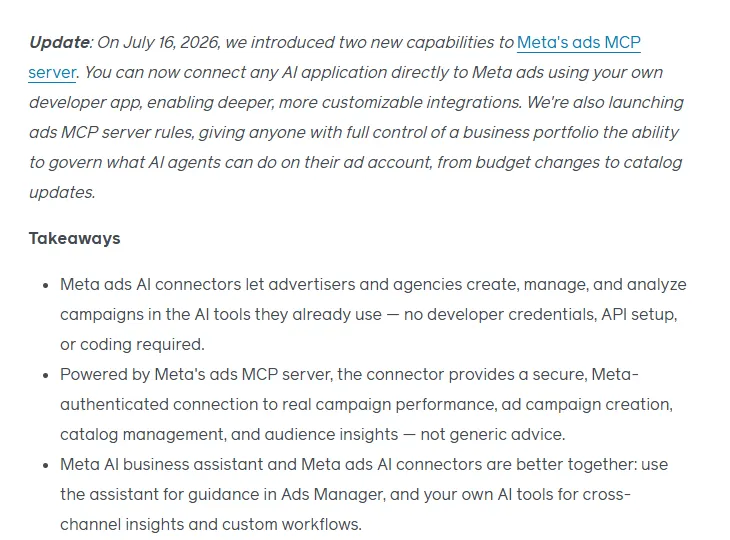
Best for: advertisers who only run Meta adsMeta has three layers of AI for advertisers. Advantage+ applies AI to a campaign's audience, placements and budget. The Meta AI business assistant gives campaign recommendations, performance insights and account support in chat, and lets you apply a recommendation with one click. Meta ads AI connectors, announced on 29 April 2026, link an ad account to an outside AI agent through Meta's ads MCP server and command line tool, to create and edit campaigns, pull reports, manage catalogs and check signal health.
- Control: on 16 July 2026 Meta added ads MCP server rules, which let anyone with full control of a business portfolio govern what AI agents can do on the ad account, from budget changes to catalog updates.
- Availability: Meta says the business assistant is in beta and available to most businesses; the connectors are in open beta.
- Price: no separate fee listed; you pay for ad spend.
Strengths
- No separate fee listed, and built into the tools you already use
- Connectors let an AI tool you choose work on the account, under rules you set
Limits
- Meta only, so Google campaigns need a separate setup
- The assistant recommends; connectors need your own AI tool and rules
Pick this instead of CamClo AI if you only advertise on Meta, make your own creative, and are happy to act on recommendations yourself.
3. Google's built-in AI (Ask Advisor, AI Max, Performance Max)
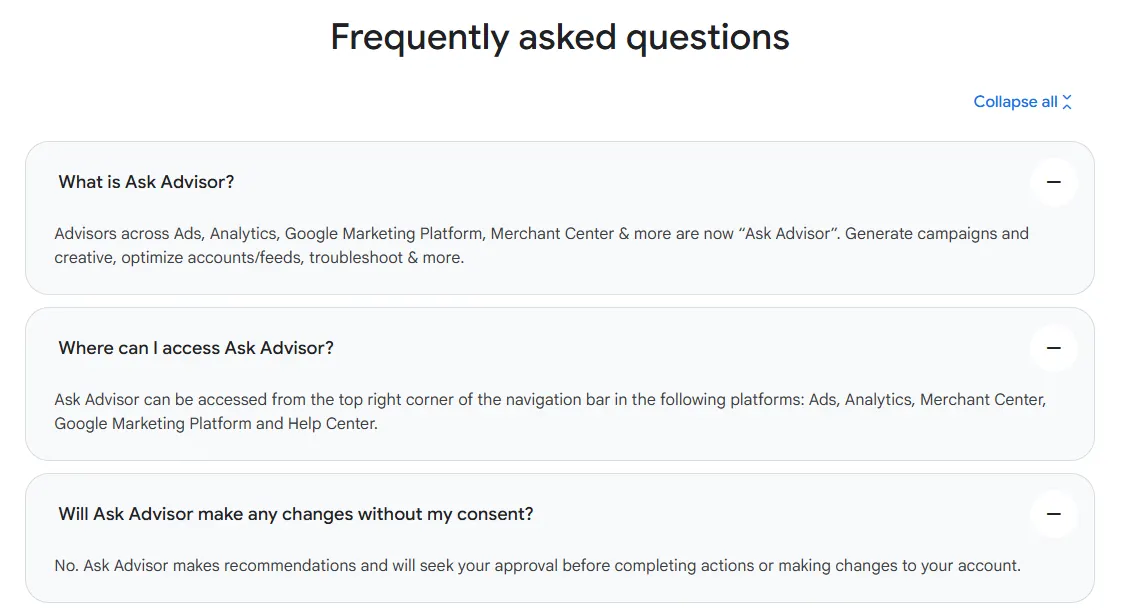
Best for: advertisers who only run Google AdsGoogle introduced Ask Advisor on 20 May 2026. Google says its advisors across Ads, Analytics, Google Marketing Platform, Merchant Center and more are now one agent, built with Gemini, that can generate campaigns and creative, optimize accounts and feeds, and troubleshoot. Inside campaigns, AI Max for Search adds improved search term matching, text customization and final URL expansion, and Performance Max is a goal-based campaign type that reaches YouTube, Display, Search, Discover, Gmail and Maps from one campaign.
- Control: Google says Ask Advisor makes recommendations and will seek your approval before completing actions or making changes to your account.
- Availability: in beta for English-language accounts; Google's help center says it is not available in manager (MCC) accounts.
- Price: no separate fee listed; you pay for ad spend.
Strengths
- No separate fee listed, and asks before every change
- Spans Ads, Analytics and Merchant Center, with more features rolling out
Limits
- Google only, in beta, and not in manager accounts
- Every change waits for your approval, so nothing moves while you are away
Pick this instead of CamClo AI if Google Ads is your only channel and you want an advisor that never acts without a click from you.
4. Amazon Ads Agent
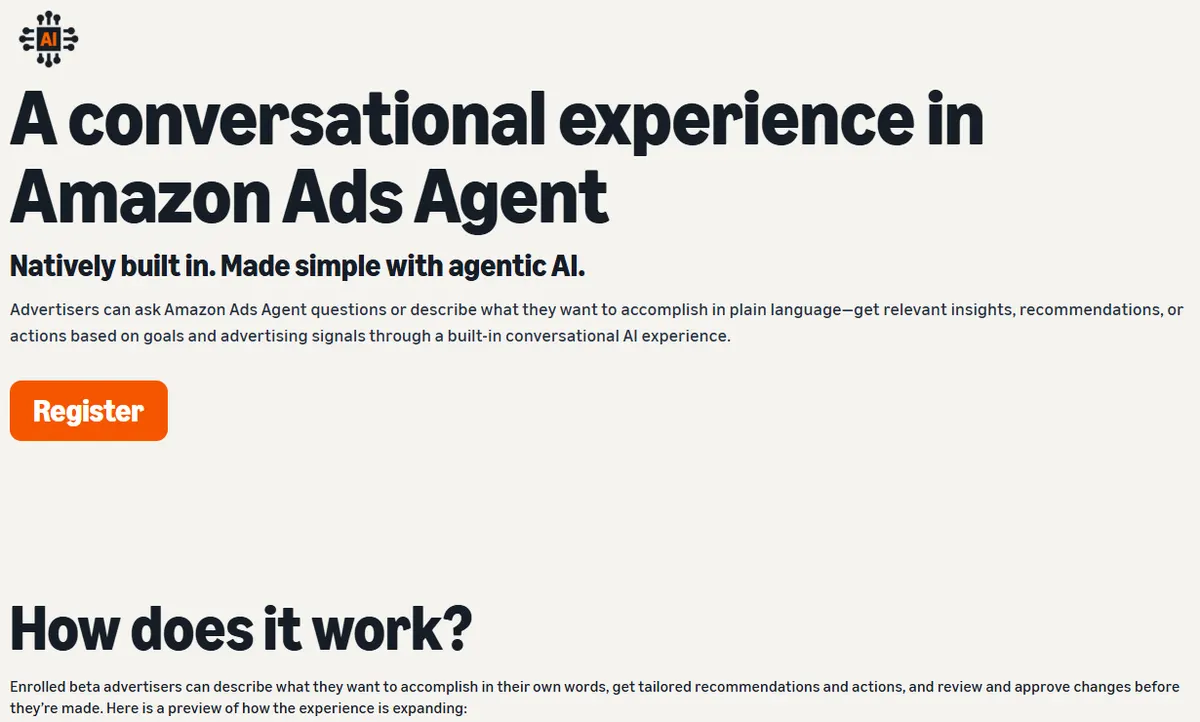
Best for: brands advertising on AmazonAmazon Ads Agent is a conversational agent built into Amazon Ads. Amazon says it sizes audiences, forecasts reach and recommends budgets; turns a media plan into Display, Video and Audio campaigns; makes bulk changes across campaigns; applies keyword, bid and budget recommendations for sponsored ads; and writes SQL queries for Amazon Marketing Cloud from plain language. Amazon says it works for advertisers whether or not they sell in the Amazon store.
- Control: advertisers review a summary of proposed changes and approve them before they are applied.
- Availability: a rolling closed beta; Amazon suggests contacting your Amazon Ads account executive.
- Price: not listed.
Strengths
- Built into Amazon Ads, with approval before any change
- Covers sponsored ads and Display, Video and Audio
Limits
- Amazon Ads only
- Closed beta, with access depending on eligibility and marketplace
Pick this instead of CamClo AI if your ad budget goes to Amazon rather than Meta or Google.
5. AI Marketing Agent for Shopify (Enrich Labs)
Best for: Shopify stores new to marketingAI Marketing Agent is a Shopify app from Enrich Labs, and it appears in the top results for all three searches we checked. It writes SEO blog posts and social content, guides you through launching Meta and Google ads, builds welcome and abandoned-cart email flows in Klaviyo, and tracks which traffic source brings sales. It works with Google Ads, Meta Ads and TikTok for Business.
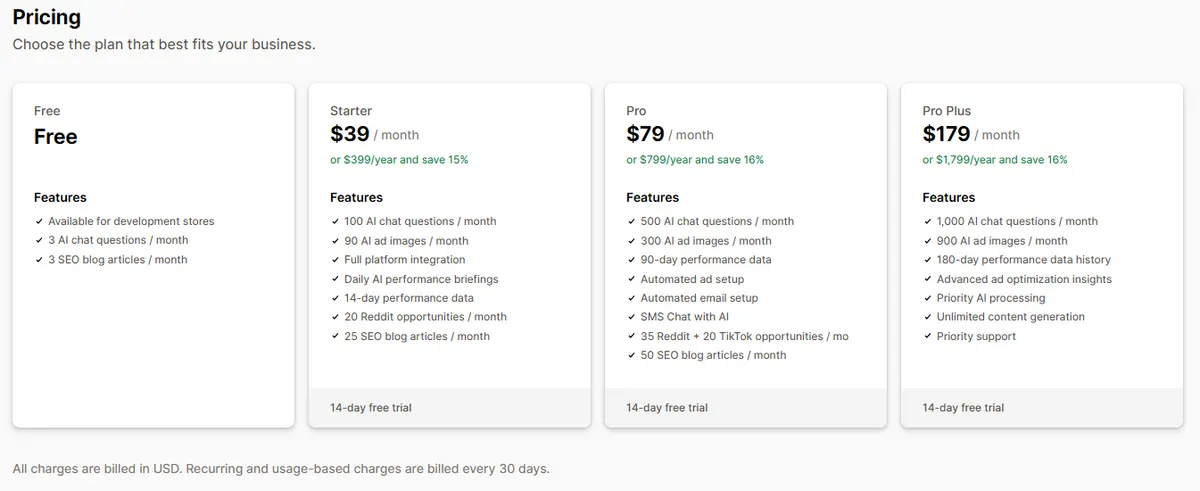
- Pricing: Starter is $39/month ($399/year) with 100 AI chat questions and 90 AI ad images a month. Automated ad setup and email setup are listed on Pro, at $79/month ($799/year). Pro Plus is $179/month.
- Free: a free plan with 3 AI chat questions and 3 SEO articles a month, and a 14-day free trial on paid plans.
Strengths
- SEO, email, social and ads in one app for a small store
- A free plan and a low entry price
Limits
- Shopify only, and automated ad setup needs the $79 Pro plan
- The listing does not describe spend caps or approval rules
Pick this instead of CamClo AI if you run a new Shopify store and want help with SEO and email as much as with your first ads.
6. Wix AI Marketing Agent
Best for: businesses with a Wix siteWix's AI Marketing Agent, which Wix calls Kleo, builds a marketing plan from your site and handles SEO, social posts, email campaigns and paid ads from the Wix dashboard. For paid ads it creates and optimizes Smart Google Ads campaigns.
- Control: Wix says Kleo will handle tasks and ask for your approval before any changes, with an email and a mobile push notification when a task is ready.
- Price: the agent uses Wix AI credits. New Wix Premium plans include AI credits, and free plans get 30 credits a day, up to 120 a month. Onboarding is free. The Google Ads campaign itself is funded separately.
Strengths
- Built into the Wix dashboard, with approval before every change
- Free to start
Limits
- Wix sites only
- Paid ads cover Google only, not Meta
Pick this instead of CamClo AI if your site is on Wix and you want SEO, email and a simple Google Ads campaign handled from one dashboard.
7. Creatify
Best for: making ad creative at volumeCreatify is an AI ad maker for UGC-style video ads with AI actors, and it ranks for "AI ads agent". It offers a Creative Agent, described as a copilot that plans, builds and ships your ads, and a Performance Agent for chatting with your ad data. Its plan comparison lists the ad launcher and AI Performance Agent for Meta, TikTok and AppLovin.
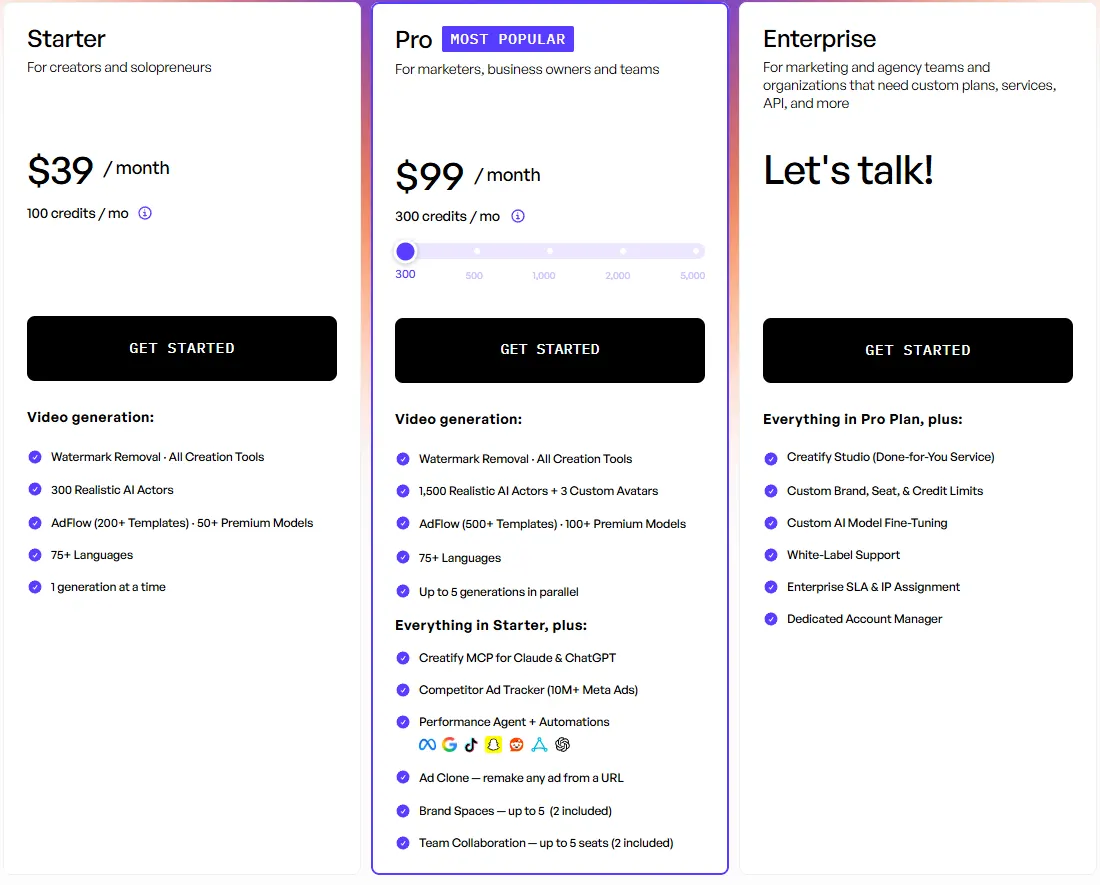
- Pricing: Starter is $39/month with 100 credits. Pro is $99/month with 300 credits and adds the Performance Agent and automations, Ad Clone and an MCP connection for Claude and ChatGPT. Annual billing saves up to 50%.
- Free: 10 credits a month, with a watermark on exports.
Strengths
- A large library of AI actors and ad templates
- Launches ads to Meta, TikTok and AppLovin from the same tool, from the Starter plan up
Limits
- The Performance Agent needs the $99 Pro plan, and the plan comparison lists the ad launcher for Meta, TikTok and AppLovin only
- The pricing page does not describe spend caps or approval rules
Pick this instead of CamClo AI if your main need is avatar-led video ads in volume and you buy media mostly on Meta or TikTok.
8. Semrush Ads AI Agent
Best for: a second opinion on your Google AdsSemrush's Ads AI Agent is a chatbot in its Advertising Toolkit. You connect Google Ads and ask questions such as which campaigns waste the most budget, and it answers from your data with recommendations for bids, budgets and targeting. Semrush says you then apply them through its Ads Launch Assistant, which creates, launches and manages ads across Google and Meta.
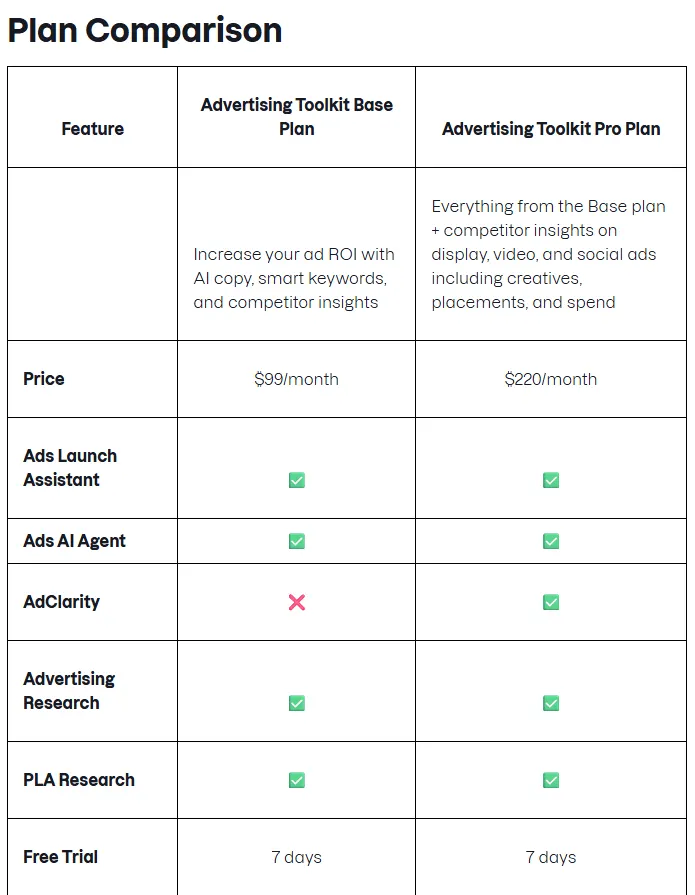
- Pricing: the Advertising Toolkit Base plan is $99/month and Pro is $220/month. Both include Ads AI Agent and Ads Launch Assistant.
- Free: a 7-day free trial.
Strengths
- Plain-language answers from live Google Ads data
- Pairs with Semrush's keyword and competitor research
Limits
- The agent reads Google Ads only
- You apply every change yourself
Pick this instead of CamClo AI if you manage Google Ads yourself, already use Semrush, and want an analyst rather than an operator.
9. Salesforce Campaign Agent
Best for: enterprise teams on SalesforceCampaign Agent, from Salesforce Marketing Cloud, ranks in the top three for "AI marketing agent". Salesforce says it creates, runs and optimizes campaigns within guardrails you set: it builds segments and content variations, and decides what to send, where and when for each customer, prioritizing and suppressing sends. Its page describes messages to your customers, not buying Meta or Google ads.
- Control: Salesforce says marketers stay in control, with reviews and approvals built in along the way.
- Availability: Salesforce says it becomes generally available in Marketing Cloud Next Advanced by October 2026, with some limitations, and that extra agentic campaigns and content generations will cost more.
- Pricing: Marketing Cloud Next Advanced is $3,250 per org per month, billed annually. The Growth edition, at $1,500 per org per month, includes Agentforce Campaign Creation.
Strengths
- Works on the customer data already in Salesforce
- Built-in reviews and approvals
Limits
- Enterprise pricing, billed annually
- Built around sends to your customer list rather than paid social and search
Pick this instead of CamClo AI if you are an enterprise on Salesforce and your priority is multi-channel journeys, SMS and WhatsApp messages to existing customers.
How we checked
We chose the tools from Google's top results and AI overviews for "AI marketing agent", "AI agent for ads" and "AI ads agent" in the US, and added Meta's own AI tools as the baseline every Meta advertiser already has. We then read each vendor's official product, pricing and help pages and saved screenshots of the public pages we could reach. For each tool we recorded the ad platforms it works on, whether it changes anything without asking, the entry price and the free option. Where a vendor does not publish something, the table says "not stated" or "not listed". For CamClo AI, we checked each capability and default against the product itself.
We did not run the agents on live ad accounts for this guide, so there are no performance scores here. Results depend on your offer, creative, tracking and budget.
How to choose an AI marketing agent
- Count your platforms. On one platform, start with its built-in AI. On Meta and Google together, an agent that covers both gives you one set of limits and one report.
- Decide how much it may do alone. Start in a mode where it proposes and you approve, and widen it once its calls match yours.
- Check that the guardrails are enforced by software. Caps, step limits and approval rules should be settings the agent cannot override, not instructions in a prompt.
- Fix tracking first. An agent can only chase the results your pixel or conversion tag records.
- Ask who makes the next ad. Ads tire, and an agent that can only move budget between tired ads runs out of moves. Our piece on curing Meta ad fatigue explains why fresh creative matters.
- Check how it charges. Per seat, per campaign, per day or as a share of spend. Compare it with what an agency or your own hours cost today.
If you are weighing an agent against hiring, our guide to AI media buyers compares tools that do a media buyer's daily work, and our comparison of Meta ad automation tools covers more options for Facebook and Instagram.
Frequently asked questions
What is an AI marketing agent?
An AI marketing agent is software that works toward a marketing goal on its own: it reads your data, decides the next step and takes it, such as launching a campaign, shifting budget or pausing a weak ad. An AI assistant only answers when you ask, and rule-based automation only follows rules you wrote. Good agents act inside limits you set and ask before big changes.
Can an AI agent run my Meta and Google ads?
Yes. CamClo AI's Ad Autopilot plans, creates and launches Meta and Google Ads campaigns, publishes them paused for your review, then proposes or makes changes within your spend caps and approval settings. Meta and Google also build AI into their own tools: Advantage+ and the Meta AI business assistant on Meta, and Ask Advisor, AI Max and Performance Max on Google. Each of those covers its own platform only.
Is it safe to let an AI agent spend my ad budget?
It can be, if the limits are enforced by the software and not left to the AI's judgment. Look for daily and monthly spend caps it cannot pass, small budget steps, approval for new spend, new audiences and new markets, pausing instead of deleting, a kill switch, and a record of every action with its reason. Start in a mode where it proposes changes and you approve them.
How much does an AI marketing agent cost?
Meta's and Google's built-in AI has no separate fee listed; you pay for your ad spend. The AI Marketing Agent app for Shopify starts at $39/month, Creatify's Performance Agent comes with its $99/month Pro plan, Semrush's Advertising Toolkit starts at $99/month, and Salesforce Marketing Cloud Next Advanced costs $3,250 per org per month, billed annually. CamClo AI plans start at $49/month with 150 credits, and each managed campaign uses 80 credits per 30 days, or 3 credits for each day the agent works.
Is there a free AI marketing agent?
For trying one out, yes. Meta's and Google's AI tools come with an ad account. CamClo AI has a 7-day free trial with 20 credits. The AI Marketing Agent app for Shopify has a free plan with 3 AI questions a month, Wix gives free sites 30 AI credits a day, Creatify has 10 free credits a month, and Semrush's Advertising Toolkit has a 7-day free trial.
Will an AI marketing agent replace my media buyer or agency?
It can take over the routine daily work: watching campaigns, moving budget, pausing weak ads, refreshing creative and writing reports. Strategy, offers, pricing and brand decisions stay with people. A sensible start is to let the agent propose changes and have a person approve them, then give it more room once its calls match your own.
Want an agent that runs your Meta and Google ads inside your limits?
Try CamClo AI free for 7 days with 20 credits.
See plans and the free trial