


Table of Contents
Revealbot is now Birch, and revealbot.com redirects to bir.ch. The best Revealbot alternatives depend on what you want to change. For an AI agent that reads your results every day, proposes changes for you to approve and also makes the ads, CamClo AI is our top pick. For Meta only, Madgicx pairs ready-made automation tactics with an AI agent. For a few safety rules, Meta's own automated rules may be enough, and Optmyzr suits accounts that spend mostly on Google.
Birch runs on rules you write: when a number crosses a line you set, it pauses, scales or alerts, as often as every 15 minutes, on Meta, Google, Snapchat and TikTok. Below are 7 alternatives from the roundups that rank for this search, with what each costs and how it decides.
We read every price and plan on the vendor's own site. Here is how we compared them.
Revealbot is now Birch: what changed
Birch announced the new name in October 2024, and says it is the same team, platform and core capabilities, such as rules, analytics and bulk creative testing. You will also see it written Bïrch. Today the product has six parts:
- Rules: nested conditions, custom metrics and 20+ actions, checked as often as every 15 minutes, across several ad accounts at once, with ready-made strategies and logs that show why an item was or was not affected.
- Stage: launches creative tests from Google Drive and Sheets into many ad accounts on Meta, TikTok and Snapchat.
- Explorer and Hub: ad performance and fatigue tracking, and server-side tracking for Meta.
- Birch AI: turns a sentence into a draft rule that you review before it goes live, and audits your rules. Draft generation is Meta only.
- Birch MCP: lets Claude, ChatGPT and other AI tools read your rules and logs, and create or edit rules, with a dry run to preview them.
Birch calls its AI "today's co-pilot" and an agent the next step. Its MCP page puts it plainly: your AI creates and edits the rules, and Birch runs them. Changes to your ads still run through rules.
How Birch (Revealbot) pricing works
Birch prices its main plans by your monthly ad spend across all the ad accounts you connect on Meta, Google, Snapchat and TikTok. For ad spend up to $10K a month:
- Essential: $49 a month, or $45 a month billed annually ($540 a year), with workspaces, post boosting, reports, Slack integration and email support.
- Pro: $99 a month, or $91 a month billed annually ($1,090 a year). The plan card adds automated rules and strategies, Explorer, Launcher, custom metrics and timeframes, an audience builder, integrations such as Google Sheets, AppsFlyer and Hyros, and live chat support.
- Higher spend: the price rises with each spend tier, for example to $249 a month for Pro up to $30K. Enterprise is a custom plan with onboarding and setup help.
- Priced separately: Stage, free for 50 uploads a month and from $500 a month for 900, and Hub, free up to 10,000 tracked events a month.
- Trial: 14 days free with no credit card. When it ends, rules and reports are disabled until you choose a plan. Birch AI has no free trial; Birch offers a demo instead.
Birch says the final price and currency are confirmed at checkout and can differ by billing country. Its pricing FAQ also says all features are available on any plan, while the plan cards list automated rules under Pro, so confirm with Birch before you choose Essential for rules.
Rules you write vs an agent that proposes changes
A rule is a sentence you write in advance: if cost per purchase has been above your target for 3 days and the ad set has spent at least a set amount, pause it. A rules engine checks that sentence on a schedule and acts the moment it is true. An AI agent works the other way round: you give it the goal, the budget limits and what it must ask about, and it reads the whole campaign and proposes what to do, with its reason.
| Rules engine (such as Birch) | AI agent (such as CamClo AI's Ad Autopilot) | |
|---|---|---|
| Who sets the logic | You write each condition and threshold | You set goals, caps and what must ask first; the agent decides what to propose |
| How often it checks | As often as every 15 minutes on Birch | A daily review, with safety checks in between |
| What it can change | The actions you wire up: pause, budgets, bids, alerts, duplicates | Budgets, pauses, targeting, creative refreshes, new ad sets, retargeting, new countries |
| How it explains itself | A log of what matched and what fired | A card with the change, the reason and the expected result |
| Weak spot | Knows only the situations you predicted; rules can conflict | Works at a daily pace; you rely on its judgment inside your caps |
| Best for | Fast, predictable guardrails you can define | Judgment calls across the whole campaign, with your approval |
Neither replaces the other. Rules are the right tool for quick, predictable protection: stop an ad set that overspends overnight, alert you when results drop. But they know only the situations you predicted, and they pile up: Birch's own AI tools offer to find rules that never fire and rules where one pauses what another starts.
An agent is better at the calls rules handle badly: whether a dip is fatigue or noise, which ad set deserves the next budget step, when a new creative or a new market is worth testing. It is slower by design, and you rely on its judgment inside your caps, which is why approval modes matter.
CamClo AI uses both. Its agent proposes the changes, and at launch it also writes stop-loss rules into your Meta ad account, pausing a campaign that spends twice its daily budget in a day or four times your target cost per purchase over 3 days with no sales. If you depend on 15-minute checks, or on rules for TikTok and Snapchat, staying on Birch may be the right call.
Quick picks by what you need
Reviews Meta and Google Ads campaigns every day, explains each proposed change and makes the next ad.
Stop Loss, Surf, Revive and Sunsetting, plus an AI Marketer, priced by ad spend.
Pause, budget, bid and notification rules inside Ads Manager.
Facebook and Instagram testing with performance triggers, from $49 a month.
Feeds, smart rules and predictive budget allocation across channels.
Meta and Google Ads recommendations from $99 a month per workspace.
Revealbot alternatives compared
| Tool | Best for | How it decides | Channels | Paid plans from | Trial or free option |
|---|---|---|---|---|---|
| Birch (Revealbot) | Custom rules, checked as often as every 15 minutes | Rules you write; Birch AI drafts them for review | Meta, Google, Snapchat, TikTok | $49/mo; Pro with rules $99/mo (up to $10K ad spend) | 14-day free trial, no card |
| CamClo AI | An agent that proposes changes for approval, plus the ads | Daily review; Co-pilot by default, each change waits for you | Meta, Google Ads | $99/mo (Studio, 330 credits); first campaign free for 30 days | 7-day trial for $1 with 20 credits |
| Madgicx | Meta-only ecommerce | Pre-built tactics, plus an AI agent on approval or autonomous | Meta (reporting for more) | $45/mo under $1K ad spend | 7-day free trial |
| Meta automated rules | A few guardrails | Rules you write | Meta | No separate fee | Included in Ads Manager |
| AdEspresso | Split testing on a small budget | Performance triggers you set | Facebook, Instagram | $49/mo (up to $1,000 ad spend) | 14-day free trial |
| Optmyzr | Google-heavy PPC accounts | Rule Engine plus optimization tools | Google, Microsoft, Amazon, Meta, LinkedIn | $299/mo ($209 billed annually) | 14-day free trial, no card |
| Smartly | Enterprise creative and media | Smart rules, triggers, predictive budget allocation | Social, CTV, programmatic | Not published | Demo |
| AdAmigo.ai | An AI agent priced per brand | Daily recommendations; auto-apply on Unlimited | Meta, Google Ads | $99/mo per workspace | 7-day free trial |
Entry paid plan on each vendor's official site, in US dollars, billed monthly unless marked. Birch, Madgicx and Optmyzr price by monthly ad spend, so the price rises as you spend more. Your ad spend itself is billed by the ad platforms. Confirm before you buy.
The best Revealbot alternatives, tool by tool
1. CamClo AI (Ad Autopilot)
Best for: an agent that proposes changes for your approval, and makes the adsCamClo AI is an AI studio for ecommerce brands, and its Ad Autopilot is an AI media buyer for Meta and Google Ads. It plans a campaign from your products, goal and past ad results, launches it once you have reviewed it, then reviews it every day.
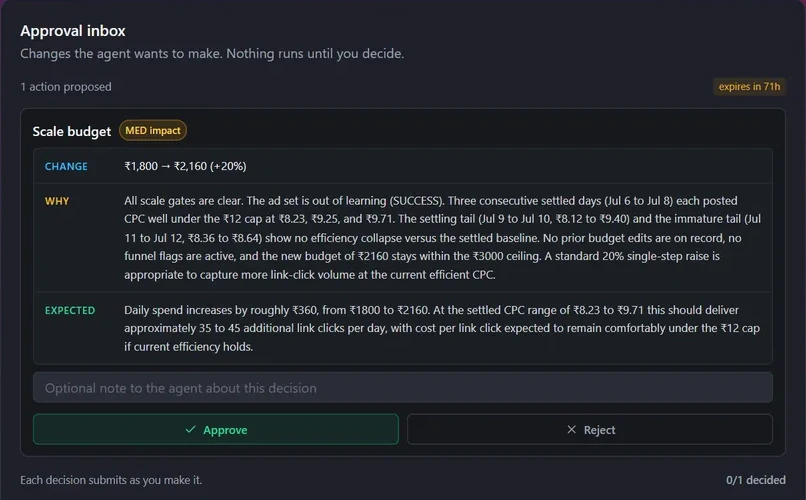
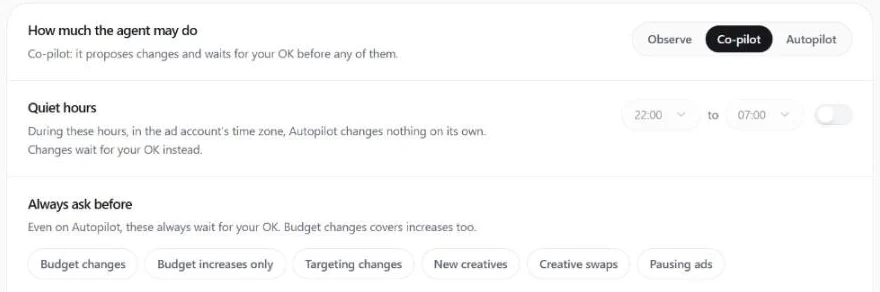
- How it decides: in Co-pilot mode, the default, each proposal is a card with the change, the reason, the expected result and any cost. Approve or reject it in the app or from the email, with links that work without signing in. A rejected idea is not proposed again for a week. Observe only watches and reports; Autopilot acts on its own, except the kinds of change you put on the Always ask before list.
- What it can propose: budget changes and moving budget between ad sets, pausing or resuming an ad or ad set, targeting changes, a creative refresh, a new ad set, a retargeting campaign, a test of new creative angles and a new country with localized ads.
- Guardrails in code: limits cap the size of each budget raise, make the agent wait between raises and hold spend inside your daily and monthly caps. Between reviews it checks for spend anomalies, zero delivery, cost spikes and broken tracking.
- Platforms and ads: Meta (Facebook and Instagram) and Google Ads (Search, Performance Max and Demand Gen). When an ad tires, it makes a fresh image or video version, in the same studio that makes image ads and video ads in 15 formats.
- Pricing: Ad Autopilot comes with the Studio plan, from $99 a month with 330 credits. Your first campaign is free for 30 days from when it starts delivering. After that a managed campaign costs 80 credits per 30 days, or 3 credits for each day the agent works, with quiet days free. The price never rises with your ad spend. Plans start with a 7-day trial for $1 with 20 credits.
Strengths
- Proposes many kinds of change, not only the ones you wrote rules for, each with a reason
- Makes the replacement ad itself when a creative tires
- A flat credit price per campaign, whatever you spend on ads
Limits
- Ad Autopilot starts on the Studio plan, at $99 a month, not on Creator. The first campaign is free for 30 days, and the price never rises with your ad spend
See how it works on the Ad Autopilot product page, and how approvals work in Facebook ads automation you approve first.
2. Madgicx
Best for: Meta-only ecommerce with ready-made tactics and an AI agentMadgicx is built primarily for Meta ads, with reporting for Google Ads, TikTok, GA4, Shopify and Klaviyo. It offers both styles: automation tactics that work like pre-built rules, and AI Marketer, its AI media buyer for Meta.
- Rules side: Stop Loss pauses underperforming ad sets and ads, Surf scales those above average, Revive brings back ones that did better than first thought because of attribution delays, and Sunsetting lowers a budget over several days before pausing. Madgicx suggests the trigger values from your account data.
- Agent side: AI Marketer audits your Facebook and Instagram campaigns and prepares the ads, audiences and other elements for each recommendation. You choose autonomous execution, or review each prepared action and click Launch.
- Pricing: Pro Complete with AI is priced by monthly ad spend: $45 a month under $1K on monthly billing, rising to $329 at $20K to $30K, and shown inside the app above that. Tracking Pro is a $49 a month add-on.
- Free: a 7-day free trial.
Strengths
- Pre-built tactics with suggested thresholds, so less rule writing
- Rules and an AI agent in one Meta toolset
Limits
- Madgicx says it does not offer Google ad management
- The price rises with your ad spend
Pick this instead of CamClo AI if you advertise only on Meta and want ready-made stop-loss and scaling tactics next to an AI agent you can run on approval or on its own.
More on this one in our Madgicx alternatives.
Side by side: CamClo AI vs Madgicx.
3. Meta's own automated rules
Best for: a few guardrails without another toolBefore you pay for a rules tool, look at what Meta includes. Ads Manager has automated rules, and Meta's developer documentation describes its ad rules engine as a service "that helps you manage ads automatically based on rules you define".
- Actions: pause or unpause, change ad set or campaign budgets, change bids, rotate to the next ad, rebalance budget away from ad sets that match, and send a notification.
- Timing: schedule-based rules run every half hour, every hour, daily at midnight or on a custom schedule; trigger-based rules are checked as soon as the data changes.
- Pricing: no separate fee; you pay only for the ads.
Strengths
- Nothing extra to connect
- Covers the core actions most teams use
Limits
- Meta only
- You write and maintain every rule yourself
Pick this instead of CamClo AI if you need a handful of rules, such as pausing an ad set that spends a set amount without a purchase, and nothing more.
More detail: our guide to Facebook ads automation covers Meta's automated rules and Advantage+ campaigns.
4. AdEspresso
Best for: split testing Facebook and Instagram ads on a small budgetAdEspresso is a Facebook and Instagram ads tool built around campaign creation and split testing. Every plan includes customized performance triggers, automatic optimization, automated promotion of Facebook posts, split testing analysis and scheduled reports.
- Pricing: Starter is $49 a month with a $1,000 monthly ad spend limit. Plus is $99 a month with unlimited ad spend, and adds cross-campaign performance triggers, multi-page bulk creation, campaign approval, up to 15 seats and white-label reports. Enterprise starts at $259 a month.
- Free: a 14-day free trial.
Strengths
- Split testing and its analysis in one place
- Clients can approve campaigns before they go live, on Plus
Limits
- Facebook and Instagram only
- Starter caps ad spend at $1,000 a month
Pick this instead of CamClo AI if you mainly test audiences and creatives on Facebook and Instagram and want clients to approve campaigns before they go live.
5. Optmyzr
Best for: Google-heavy accounts that want a deep rule engineOptmyzr is a PPC toolkit for Google Ads, Microsoft Ads and Amazon Ads, with tools for Meta and LinkedIn. Its Rule Engine runs custom strategies you build, next to search query and Performance Max optimizations, audits, budget pacing, alerts and an AI assistant.
- Pricing: plans are set by monthly ad spend. At the lowest spend level, Essentials is $209 a month billed annually, or $299 billed monthly. Essentials covers up to 25 accounts; Premium has unlimited accounts and adds Shopping management, cross-platform budget tools and the full Meta and LinkedIn tools. Enterprise is custom.
- Free: a 14-day free trial with no credit card required.
Strengths
- A Rule Engine plus search-specific tools
- Covers Microsoft and Amazon Ads as well as Google
Limits
- The full Meta and LinkedIn tools are on Premium
- The price rises with your ad spend
Pick this instead of CamClo AI if most of your budget goes to Google, Microsoft or Amazon Ads and you want rules plus search tools such as search query and Shopping management.
6. Smartly
Best for: enterprise teams running creative and media at scaleSmartly is an AI advertising platform with suites for creative, media and intelligence. Its media suite launches and manages hundreds of campaigns at once across the major social channels: you plug in product feeds, set smart rules and automated triggers, rotate ads to curb fatigue, and let predictive budget allocation shift spend toward winners. It also covers CTV and the major DSPs.
- Pricing: not published; Smartly sells through a demo.
- Free: none listed.
Strengths
- Creative production and media automation on one platform
- Budget allocation across channels, not one platform at a time
Limits
- No public pricing
- Sized for large teams and budgets
Pick this instead of CamClo AI if you run large budgets across social, CTV and programmatic and want feeds, creative and media automation on one enterprise contract.
More on this one in our Smartly.io alternatives.
7. AdAmigo.ai
Best for: an AI agent at a flat price per brandAdAmigo.ai says it designs, launches and optimizes your Meta and Google ads every day, inside the limits you set, with optimization recommendations, a chat agent and AI-made image and video ads.
- Pricing: per workspace, where one workspace is one brand with one Meta and one Google Ads account. Entry is $99 a month, for accounts spending under $2,000 a month, with 2 optimization recommendations a day. Unlimited is $349 a month, with unlimited recommendations and auto-apply for approved optimizations. AdAmigo.ai says it never raises your price automatically as ad spend grows.
- Free: a 7-day free trial.
Strengths
- A flat, published price per brand
- Recommendations, chat and ad creation in one plan
Limits
- One Meta and one Google Ads account per workspace
- The entry plan allows 2 recommendations a day
Pick this instead of CamClo AI if you want an AI agent at a flat price per brand, and one Meta plus one Google Ads account per brand fits how you work.
How to move from Birch rules to an agent
- List the rules that earn their place. Birch's rule logs show which rules fire and what they changed; drop the ones that never fire.
- Turn thresholds into limits. The cost per purchase in a pause rule becomes your target, and a budget ceiling becomes your daily and monthly cap.
- Keep a hard stop. In CamClo AI, the stop-loss rules in your Meta ad account do this; with other tools, keep one or two of Meta's own rules.
- Start on approval. Run Co-pilot for a couple of weeks, note which proposals you approve every time, then let those run on their own. Our guide to the AI media buyer covers this hand-over in more detail.
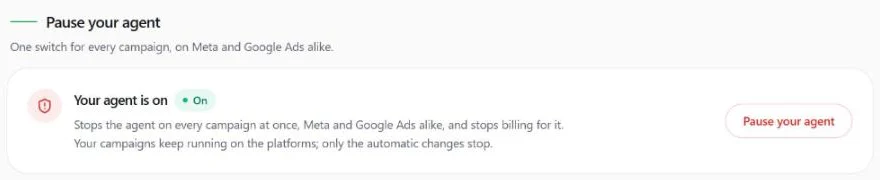
- Never let two tools change the same budget. Switch off Birch rules on the campaigns the agent manages. Birch cancels from its billing page and stays active until the end of the billing cycle.
How we compared them
We read the roundups that rank for "revealbot alternatives", "birch revealbot alternatives" and "tools like revealbot", and kept the campaign-management tools named in at least two of them. Madgicx and AdEspresso appeared in nearly every list, Meta's automated rules in many, and Optmyzr, Smartly and AdAmigo.ai in two or more.
For Birch and each alternative we read the vendor's own pricing, product and help pages. Roundups quote many different Birch prices, so the figures here come from Birch's own pricing page. We did not run a performance test, so there are no results claims here; try any tool on one campaign first.
Frequently asked questions
What happened to Revealbot?
Revealbot is now Birch. The company announced the new name in October 2024, and says it is the same team, platform and core capabilities, such as rules, analytics and bulk creative testing. revealbot.com now redirects to bir.ch, and you will also see the name written Bïrch.
How much does Revealbot (Birch) cost?
Birch prices its main plans by your monthly ad spend across all connected ad accounts. Up to $10K a month, Essential is $49 a month ($45 a month billed annually) and Pro, whose plan card adds automated rules and strategies, Explorer and Launcher, is $99 a month ($91 billed annually). The price rises with spend, for example to $249 a month for Pro up to $30K. Enterprise is custom. Stage, its tool for launching creative tests, is priced separately by uploads, with 50 a month free and paid plans from $500 a month. There is a 14-day free trial with no credit card.
What is the best Revealbot alternative?
It depends on why you are leaving. For an AI agent that proposes changes on Meta and Google Ads for your approval and also makes the ads, CamClo AI. For Meta only, with ready-made tactics and an AI agent, Madgicx. For a few rules with no extra tool, Meta's own automated rules. For split testing on a small budget, AdEspresso. For Google-heavy accounts, Optmyzr. For enterprise teams, Smartly. For an AI agent at a flat price per brand, AdAmigo.ai.
Should I use automated rules or an AI agent?
Often both. Rules are best for fast, predictable guardrails you can write in advance, such as pausing an ad set that spends a set amount without a purchase. An AI agent is better at judgment calls across the whole campaign, such as which ad set gets the next budget step or when a tired ad needs replacing. A common setup is an agent on approval for the daily decisions, with a few hard stop-loss rules underneath.
Does Birch use AI now?
Yes. Birch AI, inside the app, turns a sentence into a draft rule that you review before it goes live, answers questions about your performance and audits your existing rules; draft generation is Meta only. Birch MCP connects Claude, ChatGPT and other AI tools to your rules, rule logs and Stage launches. Birch calls its AI today's co-pilot, with an agent as the next step, and the rules still do the work.
Which Revealbot alternatives work on TikTok and Snapchat?
Few of them. Birch itself automates Meta, Google, Snapchat and TikTok ads. Smartly's media suite covers the major social channels. Madgicx reports on TikTok but is built for Meta. Optmyzr covers Google, Microsoft, Amazon, Meta and LinkedIn, CamClo AI and AdAmigo.ai run Meta and Google Ads, and AdEspresso covers Facebook and Instagram. If TikTok or Snapchat rules matter most to you, staying on Birch may be the right call.
Want an agent that asks before it changes anything?
CamClo AI has a 7-day trial for $1 with 20 credits.
See plans and the $1 trial