


Table of Contents
If you landed here because you were using Icon, or because you were seriously considering it and now need to figure out what comes next, this post is for you.
Here is the short version: Icon shut down in February 2026. The site is locked behind a password screen, the team has disappeared from LinkedIn, and users who depended on the platform lost access to their campaigns and creative assets overnight. No announcement. No migration path. No warning.
The longer version is more instructive, because what happened to Icon is not a random failure. It is a pattern. And understanding it helps you pick the next tool without making the same mistake.
This post covers:
- What actually happened to Icon and why
- What to look for in an alternative so you don't repeat the problem
- The best Icon alternatives in 2026, with real pricing and honest comparisons
- Why CamClo is the strongest alternative for ecommerce brands and agencies
- FAQ section with the questions former Icon users are actually searching
What Happened to Icon AI?
Icon launched in February 2025 with one of the loudest entrances the AI marketing space had ever seen. Founders Fund backing. Peter Thiel as an investor. A $12 million domain purchase for Icon.com, one of the largest domain acquisitions in startup history. Claims of $5 million ARR within 30 days of launch. The promise: 14 AI marketing products in one platform that would replace your creative agency, your media buyer, and roughly $2,000 to $30,000 worth of monthly marketing tools for just $39 per month.
By February 2026, exactly 12 months after launch, the site was locked behind a Vercel authentication wall. The entire team had vanished from LinkedIn. Pieter Levels, who has 541,000 followers on X, posted simply: "Icon, the AI Admaker, just went bankrupt." No official shutdown announcement was ever made by the company.
The collapse was not sudden. Users on Reddit had been describing the platform as "slow, unusable, and clunky" since mid-2025. Trustpilot had been filled with complaints about unauthorized billing after free trials, including trial cancellations that were charged anyway. By mid-2025, the website had already gone dark for stretches.
The irony that completed the story: as of March 2026, Icon's live pages still marketed "38 Human UGC ads, 100% real, not AI" at $399 per package. The company that promised to replace human ad agencies with AI had quietly pivoted to selling human-made ads, wearing the branding of a dead platform.
The Numbers Behind the Fall
- $12 million spent on the Icon.com domain purchase in April 2025
- $5 million ARR claimed within 30 days of launch (February 2025)
- 14 AI products promised in a single platform
- Less than 12 months from launch to shutdown
- $39/month base pricing that was frequently described as misleading due to forced upsells
- 5.2/10 overall rating from an independent review that tested 50+ ads over three weeks of use
- A recurring share of Trustpilot reviews were 1-star, citing billing and cancellation issues specifically
- 6 steps required to cancel a subscription, with no self-service option
Why Did Icon Actually Fail?
The $12 million domain purchase makes for a better headline, but it is not the real reason. The product failed because of a set of compounding problems that any ecommerce brand or agency should watch for in any AI tool they evaluate:
Spreading 14 products across one team. When you build 14 things simultaneously, none of them reach production quality. Users who needed reliable UGC-style video ads got something that, in the words of multiple reviews, fell into the "uncanny valley", visually off enough to reduce ad effectiveness rather than improve it. The AI voice output was described as emotionless and repetitive. Specialized tools consistently outperform bundled ones when the bundle is under-resourced.
Billing that broke trust from day one. The strongest complaints came from users who had trouble cancelling their trial or subscription. Several reviews mention charges continuing after cancellation attempts, unclear upgrade paths, and sudden jumps to higher-priced plans. These patterns showed up repeatedly on Trustpilot, Reddit, and in YouTube review comments. When a platform builds friction into the exit, it signals something about how the company views its customers.
Overpromising to hit hype metrics. The "replace $30,000 of marketing tools for $39/month" positioning was designed to generate press coverage and viral growth, not to manage expectations. Realistic promises that the product could actually deliver would have attracted fewer initial users and far more retained ones.
Venture capital as a false stability signal. Founders Fund backing did not save Icon. Neither did Peter Thiel as an investor. For founders and investors, the episode serves as a reminder that while branding and venture capital can create momentum, a startup ultimately survives or fails based on whether its product actually works.
What to Look For in an Icon Alternative
Icon's failure is a checklist for evaluating any replacement:
The five-point replacement checklist
- Transparent pricing. Full pricing should be public without a sales call. If it is not, that is a warning sign.
- Focused scope. A tool that does three things well beats one claiming to do 14. Ask what the core product actually is.
- Real user evidence. Verified G2 reviews and published case studies with numbers matter. Press coverage and investor names do not.
- An exit path. Know what happens to your creative assets and campaign data if the service shuts down. Icon users found out the hard way there was no answer.
- Creative built from your actual assets. Tools that generate imagery from scratch produce output that does not show your product. That creates editing burden and weaker ad performance.
The Best Icon Alternatives in 2026
1. CamClo: Best for Ecommerce Brands and Agencies Running Paid Social and Search
CamClo is the alternative that most directly addresses what ecommerce brands and agencies actually needed from Icon: a workflow that starts from the product itself and ends with a live campaign, without the chaos of a dozen disconnected tools.
Where Icon promised to replace your creative workflow with AI, CamClo delivers a specific version of that promise that actually works. It does not try to be 14 products. It covers the creative-to-campaign pipeline for physical product sellers and the agencies that serve them.
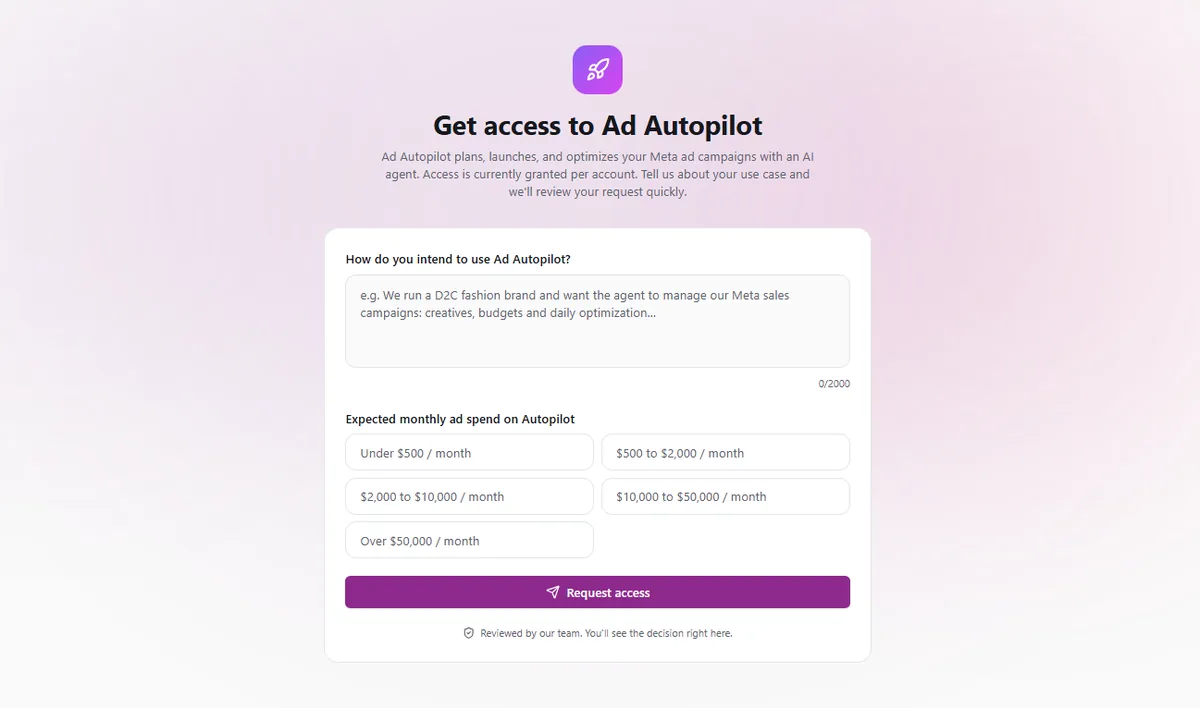
What CamClo includes:
The platform is split into two focused products.
- Virtual try-on that places your actual product on AI models without a photoshoot, so the product in the ad is your product
- AI product photography that transforms flat-lay images into lifestyle scenes
- Image ad creation generating platform-ready static ads from product images
- Video ad creation turning product images into short-form video ads
- Meta and Google Ads automation with an AI agent that manages execution
- Campaign optimization and budget management
- Delivery health checks and tracking diagnostics so you find out why an ad set is underspending before the budget is gone
- Reporting dashboards for brand teams and agencies
Why this matters specifically as an Icon alternative:
Icon's most-cited failure was creative quality. Users described AI output that looked obviously artificial, UGC avatars in the uncanny valley, and video ads that reduced rather than improved performance. CamClo sidesteps this problem at the source: because the creative is built from your actual product photography rather than generated from scratch, the output is recognizably your product. That is the difference between an ad your audience trusts and one that makes them hesitate. Our walkthrough of turning a flat-lay into on-model imagery shows what that looks like end to end.
The second reason to consider CamClo specifically as a replacement is workflow integrity. Icon's 14-product structure meant features were half-built and unreliable. CamClo's scope is narrow enough that what it does, it does completely: upload a product image, generate on-model or lifestyle creative, create the ad, launch the campaign. You do not leave the platform at any stage of that workflow.
Pricing:
CamClo uses a credit-based system with a 7-day free trial of Creator: 20 credits across every tool, card required, so you can evaluate the actual output before the first charge (trial output is watermarked; paid plans export clean). Paid plans start at $49 per month for Creator, with Studio tiers from $99 upward for higher credit volumes. The full table is on the pricing page, with no sales call required to see it, and no forced upsell into a "Managed" tier to get usable output. Cancellation is self-service, which is worth saying out loud given that cancelling Icon took a six-step support flow.
To be straightforward about the part that is the same: like most credit-based AI platforms, CamClo credits reset at the start of each billing cycle rather than rolling over. The difference is what a credit buys. Image ads cost one credit, smart edits half a credit, and virtual try-ons two, so a plan covers hundreds of assets per month rather than dozens.
The data case for on-model creative:
On-model product imagery consistently outperforms flat-lay in apparel ecommerce, and there is peer-reviewed support for why: research on advertising model body-size similarity finds that shoppers judge a product differently depending on how closely the model's body matches their own. Icon's AI-generated UGC avatars were described by reviewers as falling into the uncanny valley. CamClo's approach produces on-model imagery from the real product, which is a structurally different output than generated avatar content.
A study of more than a million Meta ad creatives found that brands shipping 20 or more new ads a month achieve 65% higher ROAS than brands testing fewer than ten. The average traditional product photoshoot costs between $2,000 and $5,000 per session. CamClo's virtual try-on brings that cost to the subscription price, which means the budget that used to go to photographers can go to media spend and creative testing instead. We broke the arithmetic down in detail in our virtual try-on ROI analysis.
Where CamClo has limitations:
There is no installable Shopify app yet. You can import a product by pasting its product URL, including from Shopify storefronts, but there is no automated catalog sync, which is a genuine gap for merchants with thousands of SKUs. Campaign management covers Meta and Google Ads, so if TikTok represents a significant share of your ad spend, you will still need a separate tool for that channel. White-label reporting for agencies is partial rather than fully built out: exported client reports carry your agency name and logo, but the report accent colour and the sending domain are still CamClo's, which matters if you are running fully branded client dashboards.
These gaps are worth knowing before you commit. The platform is actively building, but if Shopify catalog sync, TikTok campaigns or fully white-labelled reporting are hard requirements today, factor that in.
2. Wireflow: Best for Full Ad Pipeline Control
If Icon's promise of a connected creative workflow was what drew you in, Wireflow is the most honest version of that idea actually shipped. It is a visual node-based canvas that lets you chain 100+ AI models into a repeatable pipeline and call the whole thing through a single REST API endpoint. You build the workflow yourself, see every node before it runs, and control every step. No black-box agent, no half-built features.
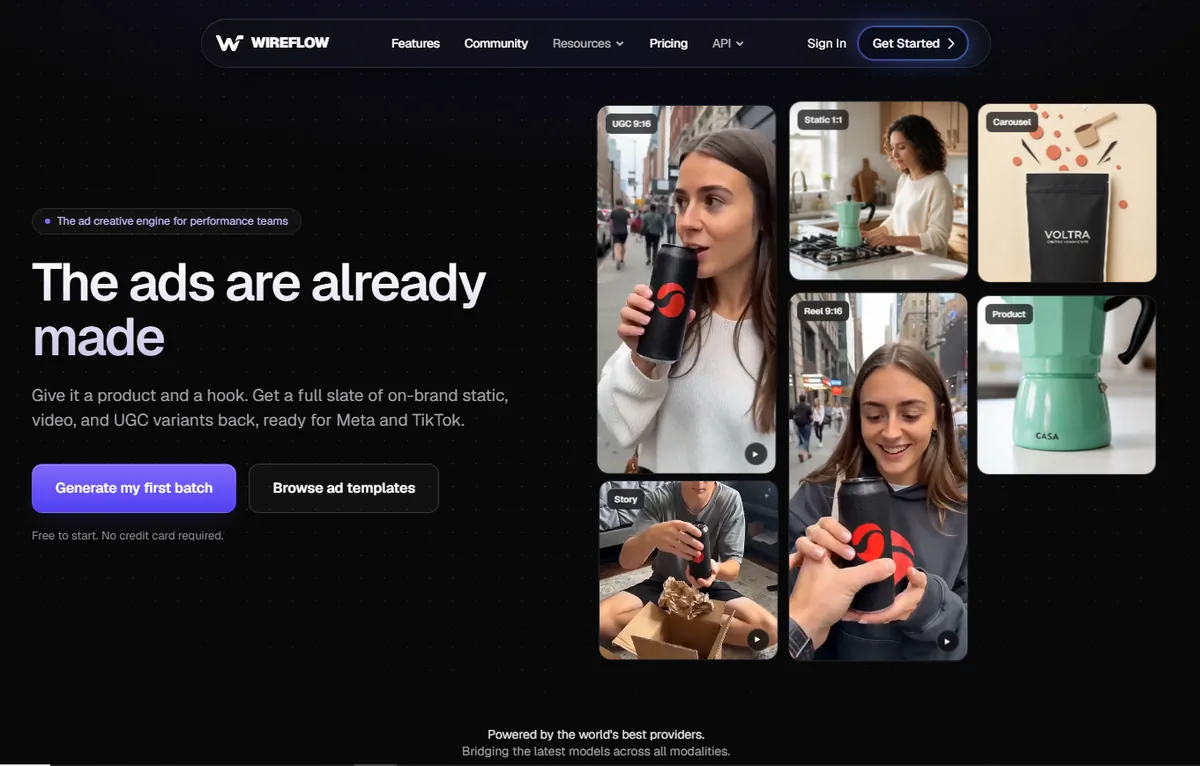
What Wireflow does:
Each node in the canvas is an AI model or transformation step. Connect a text prompt to an image generation node (Nano Banana Pro, Seedream, or any of the 100+ models it bridges), route the output through background removal, into an ad layout, then export to your channel. Every published workflow automatically becomes a REST endpoint callable programmatically. Batch generation, Photoshop and Figma plugins, and unlimited workflow spaces are included on paid plans, and there is a library of community templates if you would rather start from a working pipeline than a blank canvas.
Why it matters as an Icon replacement:
Icon claimed to automate your ad workflow but delivered brittle, buggy features. Wireflow gives you the infrastructure to build the automation yourself with complete visibility at every step. No hidden logic, no forced upgrade to unlock real functionality.
Pricing (verified August 2026):
Building on the canvas is free, with up to 5 workflows on the free plan. Paid plans: Starter $24/month for 1,600 credits, Professional $45/month for 4,300 credits, Team $249/month for 21,500 credits across 4 seats. Generations are billed per run out of that credit pool. No per-model markup. All pricing is on the public pricing page, no sales call required.
The honest trade-off: heavy production months cost more than a flat-rate plan. You pay for what you produce, not for capacity you are not using.
Where Wireflow has limitations:
Anything beyond a template is infrastructure you assemble yourself. Teams without a developer or someone comfortable in a node editor will find the learning curve steeper than CamClo. It also has no campaign management, audience intelligence, or ad reporting built in, so it stops at the creative and hands off to whatever you use to actually buy media.
Best for: Agencies with a technical operator and growth teams who want full control over a custom AI creative pipeline at scale.
3. Creatify: Best for AI Video Ads
If video was the Icon feature you relied on most, Creatify is the most focused replacement available. It specializes in AI video ad creation without spreading resources across 14 other categories, which is the exact discipline Icon lacked.

What it does:
URL-to-video workflows that generate video ads from a product page link. AI avatar content optimized specifically for TikTok and Meta Reels formats. A free tier with 10 monthly credits for evaluation without adding billing information.
Pricing (verified August 2026):
Free tier with 10 monthly credits. Starter at $39 per month for 100 credits, Pro at $99 per month for 300 credits, with custom enterprise pricing above that.
The honest comparison:
Creatify does not handle campaign management, creative analytics, delivery diagnostics, or product photography. It is a video creation tool and only a video creation tool. You will still need a separate platform to launch and manage campaigns. If you want video creation and campaign management without adding another tool to your stack, pair Creatify with CamClo's Ad Studio rather than managing them as two entirely separate workflows.
The other limitation worth flagging: Creatify's AI avatar output is generated from scratch rather than from your actual product footage. For ecommerce brands where the product itself needs to be the recognizable hero of the video ad, this creates the same underlying quality problem that made Icon's UGC output ineffective. It is less severe than Icon's execution, but the structural issue is the same. If you want to see the alternative approach, our guide to turning product photos into ecommerce video ads covers generating video from the real product instead.
Best for: Brands who need high-volume short-form video content for TikTok and Reels and are comfortable managing campaigns in a separate tool.
Feature Comparison: Icon vs the Alternatives
| Feature | Icon (shut down) | CamClo | Wireflow | Creatify |
|---|---|---|---|---|
| Platform status | Shut down Feb 2026 | Active | Active | Active |
| Virtual try-on | No | Yes | No | No |
| AI product photography | No | Yes | Via pipeline | No |
| Image ad creation | Claimed, buggy | Yes | Yes (100+ models) | Yes |
| Video ad creation | Claimed, uncanny valley | Yes | Yes (Kling, Seedance, Veo) | Yes (core feature) |
| Meta campaign automation | Claimed, buggy | Yes | No | No |
| Google Ads campaign automation | No | Yes | No | No |
| TikTok campaign automation | No | No | No | No |
| AI audience targeting | No | Yes | No | No |
| Creative performance scoring | Shallow per reviews | Yes | No | No |
| Delivery health and tracking diagnostics | No | Yes | No | No |
| Batch generation | No | Yes (bulk catalogue upload) | Yes | Yes |
| Shopify catalog sync | No | No (product URL import only) | No | No |
| White-label for agencies | No | Partial | No | No |
| Free entry tier | 3-day trial (credit card required) | Yes (7-day trial, 20 credits, card required) | Yes (build free, pay per gen) | Yes (10 monthly credits) |
| Transparent pricing | No (forced upsells) | Yes | Yes (public page, no sales call) | Yes |
Why CamClo is the Strongest Choice for Ecommerce Brands
Most alternatives to Icon focus on one side of the problem: either creative generation or campaign management. CamClo covers both, and does it starting from your actual product photography rather than generic AI imagery.
Icon's creative output landed in the uncanny valley because it generated imagery from scratch. The product in the ad was not your product. CamClo starts from your uploaded photos, so the product buyers see in the ad is the one they are about to buy. On-model imagery of the real product outperforms flat-lay in apparel, and shoppers respond more strongly when the model resembles them. That lift does not come from generic AI content.
The cost case is also direct. A traditional photoshoot costs between $2,000 and $5,000 per session. Brands need 30 to 50 creative variations per product to test properly. CamClo's virtual try-on replaces that spend with a subscription, freeing the photography budget for media spend instead. If creative fatigue is what is actually eating your returns, our post on curing Meta ad fatigue covers the refresh cadence that volume makes possible.
The gaps are real too. No Shopify catalog sync yet, no TikTok campaign management, and white-label reporting is partial. If those are hard requirements today, factor that in before committing. For a wider view of where CamClo sits against the dedicated campaign tools, we published a full CamClo alternatives comparison that does not pretend we win every category.
Key Data Points
The numbers worth remembering
- Icon spent $12 million on the Icon.com domain and shut down 12 months later
- An independent reviewer scored Icon 5.2 out of 10 after testing 50+ ads over three weeks
- Icon's Trustpilot page carries repeated 1-star reviews, primarily citing billing and cancellation
- Cancelling Icon required a 6-step support flow with no self-service option
- Shoppers judge a product differently depending on how closely the model resembles them (Journal of Consumer Behaviour)
- Brands shipping 20+ new ads a month achieve 65% higher ROAS than brands testing fewer than ten (study of 1M+ Meta creatives)
- Traditional product photography costs $2,000 to $5,000 per session (Shopify)
- Wireflow supports 100+ AI models with plans from $24 per month, building free
Rebuild on something that is still here next year
Product photography, virtual try-on, image ads, video ads and an AI agent that runs your Meta and Google campaigns. One platform, public pricing, with a 7-day free trial.
See CamClo PricingFrequently Asked Questions
What happened to Icon AI?
Icon launched in February 2025 with Founders Fund backing, Peter Thiel as an investor, and a $12 million domain purchase. It shut down in February 2026 with no official announcement. The site locked behind a password screen, the team disappeared from LinkedIn, and user campaigns and assets became inaccessible overnight.
Can I still use Icon?
No. Icon is not operational. The domain is locked and no customer support is available. You need to rebuild with a new tool.
What is the best replacement for Icon for ecommerce brands?
CamClo. It covers the workflow Icon promised: product photography, ad creation, and Meta and Google Ads campaign management without switching platforms. The difference is that CamClo starts from your actual product photos rather than generating generic AI imagery.
What is the best Icon replacement for agencies?
CamClo for ecommerce-focused agencies managing Meta and Google Ads campaigns. Wireflow for agencies with a technical operator who want a fully custom, API-driven creative pipeline across multiple clients. Creatify for agencies focused on TikTok and Reels video volume.
Why did Icon fail after raising so much money?
It built 14 products simultaneously, so none reached production quality. Billing practices eroded trust early, with charges continuing after cancellation attempts. And the product quietly pivoted to human-made ads by mid-2025, which was the opposite of what it had promised.
How do I avoid picking another tool that shuts down?
Check four things: Is pricing published publicly without a sales call? Does the product focus on a specific workflow rather than claiming to replace 14 tools? Are there verifiable reviews with real results? And can you export your assets if the service shuts down? Icon offered none of these.
Is there a free alternative to Icon?
Yes. CamClo offers a 7-day free trial of its Creator plan with 20 credits across every tool (trial output is watermarked; paid plans are watermark-free); a card is required, and cancelling before the trial ends costs nothing. Wireflow lets you build on the canvas for free and only charges per generation when you run a workflow. Creatify has a free tier with 10 monthly credits. None require billing information just to evaluate the product.
Did Icon refund users after shutting down?
There is no public record of a refund process or user communication. If you were charged, contacting your bank or card issuer to dispute the charge is the most practical path.
How is CamClo different from Wireflow?
CamClo is a finished product: upload a product image, generate creative, launch to Meta or Google Ads. No setup required. Wireflow is closer to a creative engine you assemble yourself, with a visual node canvas where you chain 100+ models into your own pipeline, callable via API. CamClo is faster to start and includes campaign management. Wireflow gives more control over the generation pipeline but stops at the creative.
Do CamClo credits roll over each month?
No. Like most credit-based AI platforms, CamClo credits reset at the start of each billing cycle rather than accumulating, so unused credits do not carry forward. What is different from Icon is everything around the credits: pricing is public with no sales call, there is a 7-day free trial you can evaluate on before the first charge, and cancellation is self-service rather than a six-step support flow.
Is CamClo only for fashion brands?
No. The virtual try-on is most applicable to apparel and accessories, but the AI product photography, image ads, video ads and campaign automation work across all ecommerce categories including home goods, beauty, and lifestyle products.
Sources
- Icon, the AI ad startup, shuts down after spending $12M on the Icon.com domain (Tech Startups)
- Icon spent $12M on a domain, failed to build working AI, and quietly became the agency it promised to replace (CTOL Digital)
- Peter Thiel-backed AI ad startup may have shut down (AdTechRadar)
- Icon AI Admaker review, an independent hands-on review across 50+ ads and three weeks
- Icon customer reviews on Trustpilot
- Meta creative volume and ROAS, from a study of more than a million ad creatives (Confect)
- Shopify, product photography pricing
- Vazquez et al., advertising model BMI similarity and perceived product quality, Journal of Consumer Behaviour
All pricing is subject to change. Verify directly with each provider before purchasing. Competitor pricing and feature information was verified in August 2026 from publicly available sources. Icon's shutdown details, review scores and user complaints referenced here are drawn from published reviews on Trustpilot, Reddit and independent review sites and reflect the experiences reported by those reviewers. CamClo offers a 7-day free trial of its Creator plan (card required, cancel anytime).