

Table of Contents
The best AI image to video tools for ecommerce in 2026 are CamClo AI for product videos and video ads made from a product photo, Google Veo and Kling for clips with sound at a low price per second, Runway and Luma for directed or high-volume clips, and Canva or Adobe Firefly for quick free clips. Which one fits depends on five things: how well it keeps your product's details, whether it makes vertical video, how long a clip can run, whether it adds sound, and what a second of video costs.
We checked every price and spec on the vendor's own site. Here is how we compared them.
Quick picks by use case
Eight video models, vertical formats and 15 video ad formats, all starting from your product photo.
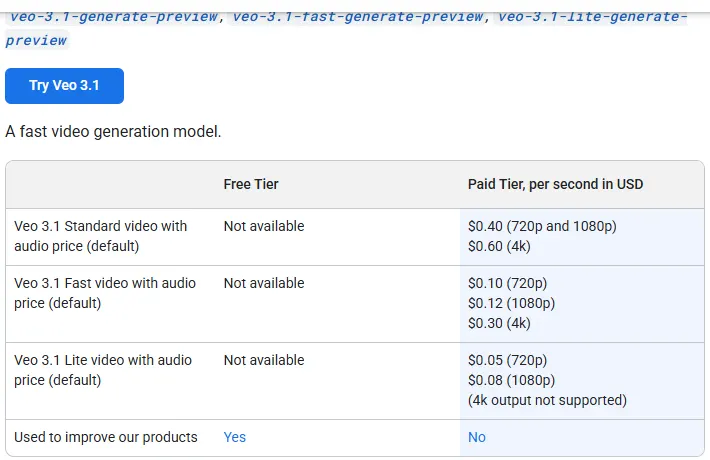
Veo 3.1 Lite on the Gemini API: $0.05 per second of 720p video, with sound.
Gen-4.5 follows detailed camera and timing prompts, in six aspect ratios.
MiniMax H3 makes 2K clips with stereo sound, up to 15 seconds.
The Firefly Video Model is trained on licensed and public domain content.
Best AI image to video tools compared
| Tool | Best for | Paid plans from | Free option | Longest clip | Sound |
|---|---|---|---|---|---|
| CamClo AI | Product videos and ads from a photo | $49/mo | 7-day trial for $1 with 20 credits | 30 s per clip; ads up to 90 s | Yes, on most models |
| Google Veo 3.1 | Lowest price per second at 720p | API from $0.05/sec; Google AI plans vary by country | Not on the API | 8 s, extendable to 148 s | Yes |
| Kling | Sound on a small plan | $6.99 first month, then $8.80/mo | Basic plan, no monthly credits | 15 s (Kling 3.0) | Yes |
| Runway | Directing every shot | $15/mo ($12/mo billed yearly) | 125 one-time credits | 10 s (Gen-4.5) | Separate sound tools |
| Luma | Silent clips at volume, HDR | $30/mo | None listed | 10 s (Ray3.2) | Third-party models only |
| Hailuo | 2K with a per-second price | $10.50/mo (discounted from $14.99) | One-time trial credits | 15 s (MiniMax H3) | Yes |
| Adobe Firefly | A commercially safe model | See vendor site | Free daily generations | About 5 s | Not stated |
| Pika | Many models in one app | $10/mo (commercial license from $35/mo) | Free plan, credit packs only | 30 s multi-shot (Video Studio) | Yes, plus Pika Soundtrack |
| Creatify | Ads from a product link | $39/mo | 10 credits a month, watermarked | 2 min videos on Starter | AI actor voices in 75+ languages |
| Canva | Free quick clips | See vendor site | Free on every plan | 3 s | Add audio in the editor |
Entry paid plan on each vendor's official site, in US dollars, billed monthly unless marked. "See vendor site" means the official page showed only regional prices from where we checked, so we could not confirm a US dollar price. Promotions change often, so confirm before you buy.
What a second of video costs
Plan prices hide how much video you actually get, so we worked out the cost of one second of video from each vendor's own numbers. Google, Kling and Hailuo publish a per-second price. For the others, we divided the monthly plan price by the seconds of video its credits buy.
| Tool and model | Plan used | Price per second | Notes |
|---|---|---|---|
| CamClo AI | Creator, $49/mo for 150 credits | About $0.13 (Kling 2.5 Turbo), $0.16 (Veo 3.1 Lite with sound), $0.42 (Seedance 2.0, 720p) | Larger plans lower the price per credit |
| Google Veo 3.1 | Gemini API, pay as you go | $0.05 (Lite), $0.10 (Fast), $0.40 (Standard) at 720p | With sound; 4K on Fast and Standard |
| Kling 3.0 | Kling API list price | $0.084 without sound, $0.126 with sound at 720p | $0.42 at 4K |
| Hailuo, MiniMax H3 | Standard, $10.50/mo for 1,000 credits | $0.074 at 768p, $0.126 at 2K | As shown in Hailuo's plan picker |
| Luma Ray3.2 | Plus, $30/mo for 10,000 credits | About $0.06 at 720p, $0.24 at 1080p | No sound from Ray3.2 |
| Pika | Starter, $10/mo for 900 credits | About $0.27 (Seedance 2.5), $0.07 (Wan 3.0) at 720p | No commercial license on Starter |
| Runway Gen-4.5 | Standard, $15/mo for 625 credits | About $0.29 | Gen-4.5 outputs 720p |
Worked out from each vendor's pricing page, on monthly billing. Adobe Firefly, Canva and Creatify do not price video by the second, so they are not in this table. A cheap second is only cheap if the clip is usable, so leave room for retakes.
The best AI image to video tools, tool by tool
Each entry covers what the tool is, what it is best for, its price, its strengths and limits, and when you should pick it instead of CamClo AI.
1. CamClo AI
Best for: product videos and video ads from a product photoCamClo AI is an AI studio for ecommerce and fashion teams. You start from your product photo and choose the output: a short clip that animates the photo, a finished video ad in a format such as UGC, unboxing or try-on, or a proven ad remixed around your product. Eight video models sit behind one workflow, so you can switch models without switching tools.
- Image to video models: Seedance 2.5 (4 to 30 seconds, up to 1080p), Seedance 2.0 (4 to 15 seconds), Google Veo 3.1 (4, 6 or 8 seconds, up to 4K), Kling 3.0 (5, 10 or 15 seconds), Gemini Omni Flash (3 to 10 seconds, up to 4K) and earlier Kling versions.
- Keeping the product right: Seedance takes up to 9 reference images and Gemini Omni Flash up to 5, so you can add more angles of the product. Veo 3.1, Kling 3.0 and Gemini Omni Flash also take an end frame.
- Vertical and square: 9:16 on Seedance, Veo 3.1 and Gemini Omni Flash; Seedance also makes 1:1, 4:3, 3:4 and 21:9.
- Sound: always generated on Seedance and Gemini Omni Flash, and optional on Veo 3.1, Kling 3.0 and Kling 2.6 Pro.
- Edit and extend: Video Edit changes an uploaded 3 to 10 second clip from a prompt, and Video Extend continues it by 3 to 10 seconds.
- Video ads: 15 formats, including UGC, UGC Virtual Try-On, Unboxing, Product Showcase, Product Demo, ASMR and TV Spot. The script is written for you, and each ad is sized for placements such as Reels, TikTok, Shorts and feeds, at 480p, 720p or 1080p, from 4 to 30 seconds. Remix Ads rebuilds a proven ad around your product, up to 90 seconds.
- Pricing: plans from $49 per month with 150 credits. A 5-second Kling 2.5 Turbo clip costs 2 credits, an 8-second Veo 3.1 Lite clip at 720p with sound costs 4, a 10-second Seedance 2.0 clip at 720p costs 13, and a 30-second Seedance 2.5 clip at 720p costs 50. There is a 7-day trial for $1 with 20 credits.
Strengths
- Starts from your product photo, with extra reference images, so the product on screen is the one you sell
- Eight video models in one place, including 30-second Seedance 2.5 clips
- Vertical, square and widescreen sizes for every channel
- Video ad formats with the script written for you, not just raw clips
- Edit or extend a clip, and remix proven ads up to 90 seconds
Limits
- Can seem a little expensive next to a single model's own app, but the credits also cover several models in one place, the ad formats and the sizing for each placement, not just a raw clip
To animate product photos, see the AI image to video tool for product photos. For finished ads with a script, see the video ad maker that starts from a product photo.
2. Google Veo
Best for: the lowest price per second at 720p, with soundVeo is Google's video model. Veo 3.1 makes clips with native audio from text or an image, in landscape (16:9) or portrait (9:16). Developers pay per second on the Gemini API, and Google AI plans include Flow credits for video generation in Google's apps. Google's own docs now suggest its newer Gemini Omni Flash as the default video model, and keep Veo 3.1 for scene extension and last-frame control.
- API pricing: per second of video with sound, Veo 3.1 Lite costs $0.05 at 720p and $0.08 at 1080p, Fast $0.10 at 720p, and Standard $0.40 at 720p or 1080p. Fast and Standard also render 4K.
- Output: clips of 4, 6 or 8 seconds. On Standard and Fast (not Lite), a clip can be extended by 7 seconds at a time, up to 148 seconds, at 720p.
- Plans: Google AI Plus, Pro and Ultra include 200, 1,000 and 10,000 or more Flow credits a month. Prices differ by country, so see vendor site.
Strengths
- The lowest per-second price we found for 720p with sound
- Portrait 9:16 for Reels, TikTok and Shorts
- Extension to long single scenes at 720p
Limits
- 8-second clips; longer ones mean chaining extensions
- The per-second prices need a developer and the API
- No product or ad workflow; you write every prompt
Pick this instead of CamClo AI if you have a developer and want the lowest cost per clip at volume, or you already pay for a Google AI plan. For plan-by-plan detail, see our Veo 3 pricing guide.
3. Kling
Best for: clips with sound on a small planKling is Kuaishou's video platform. The Kling 3.0 series, including 3.0 Omni, generates video and audio together from text or images, in clips of 3 to 15 seconds according to Kling's own guide, with native 4K output. Kling's homepage now promotes Kling 4.0; its pricing page listed Kling 4.0 Flash as early access on the yearly Ultra plan.
- App pricing: Standard is $6.99 for the first month, then $8.80 a month on monthly billing, with 660 credits, 1080p and 4K generation, watermark removal and commercial use.
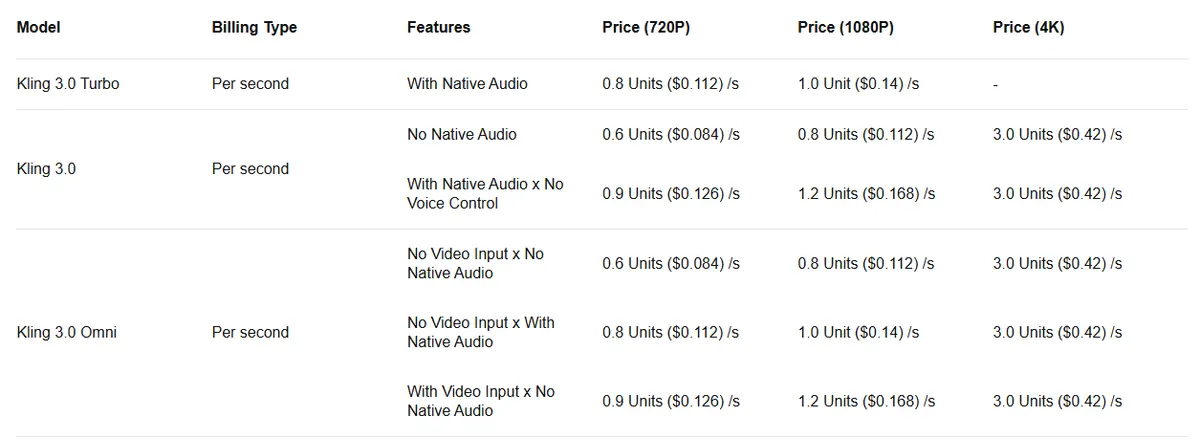
- API pricing: Kling 3.0 costs $0.084 per second at 720p without sound and $0.126 with sound. The API also lists e-commerce solutions such as Goods Studio and Video Commerce.
- Free: a Basic plan with no monthly credits.
Strengths
- A low entry price for a current model with sound
- Clips up to 15 seconds and native 4K
- Commercial use from the first paid plan
Limits
- The first-month price is a one-time offer
- The plan page does not list credits per clip at 720p or 1080p
- API packages on the 180-day plan start at $700
Pick this instead of CamClo AI if you want the cheapest direct access to Kling, or you are building on its API and its e-commerce solutions. See our Kling AI pricing guide for every plan.
4. Runway
Best for: directing camera moves shot by shotRunway is a creative video studio. Its Gen-4.5 model turns text or an image into video and follows detailed instructions on camera moves, timing and composition. Clips run 2 to 10 seconds at 720p, in 16:9, 9:16, 1:1, 4:3, 3:4 or 21:9. Plans also include Aleph 2.0 for editing footage, third-party models such as Kling 3.0 and Seedance, and music, voice and sound effects tools.
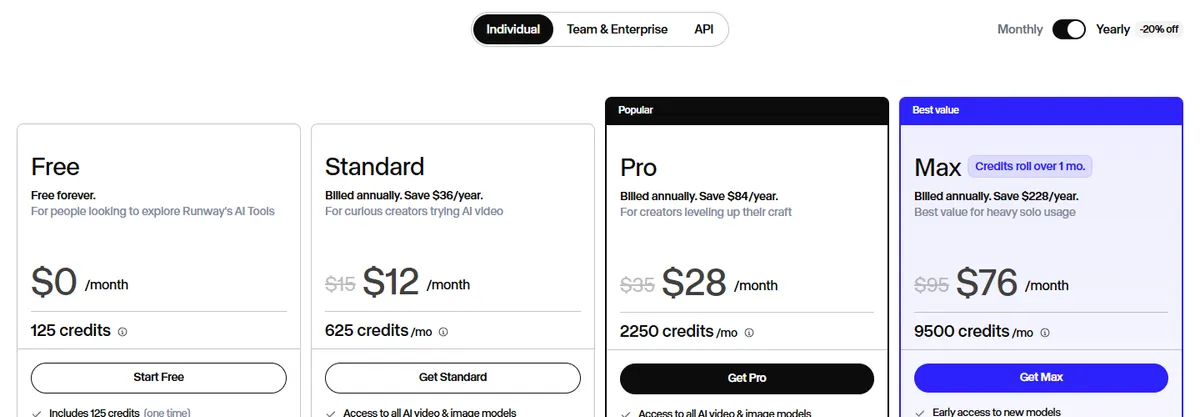
- Pricing: Standard is $15 a month, or $12 a month billed yearly, with 625 credits. Runway says that covers 52 seconds of Gen-4.5, at 12 credits per second. No watermarks, and 4K upscaling.
- Free: 125 one-time credits.
Strengths
- Precise control of camera and timing in one prompt
- Six aspect ratios, including 9:16
- Edits existing footage with Aleph 2.0
Limits
- Gen-4.5 outputs 720p, so larger sizes need upscaling
- Standard's 625 credits cover under a minute of Gen-4.5 a month
- Credits on Standard and Pro do not roll over
Pick this instead of CamClo AI if you want to direct every camera move yourself or edit footage you already shot. Our Runway pricing guide breaks down each plan.
5. Luma
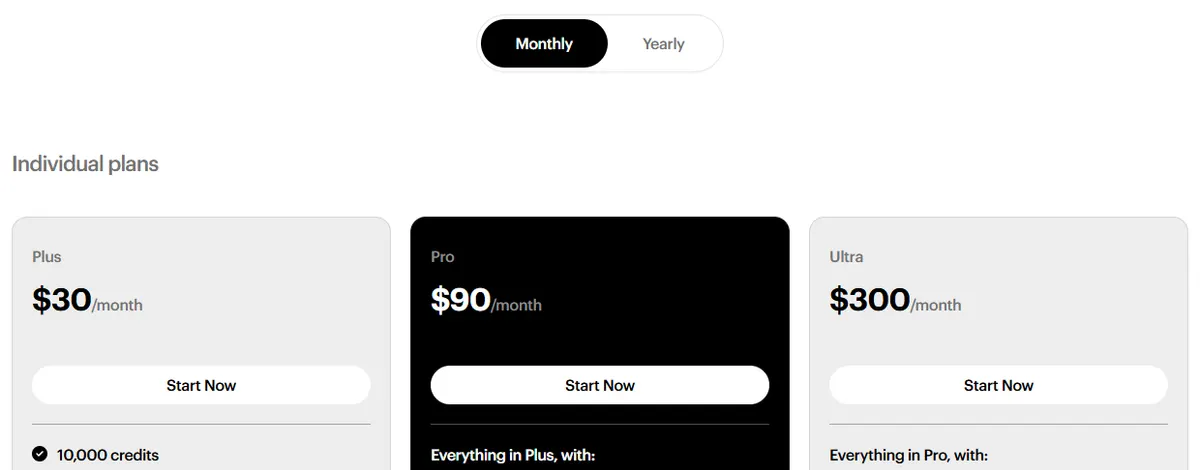
Best for: silent 720p clips at volume, and HDRLuma's Ray3.2 model turns text or an image into 5- or 10-second clips at up to 1080p, with HDR and EXR options for color grading. Luma's product-video page says you can set duration, resolution and orientation for Reels, Shorts or store galleries. Plans also include third-party models, among them Seedance 2.5, Kling 3.0, Veo 3.1, MiniMax H3 and Gemini Omni Flash.
- Pricing: Plus is $30 a month with 10,000 credits and commercial use. A Ray3.2 image-to-video clip costs 100 credits per 5 seconds at 720p and 400 at 1080p.
- Free: no free plan is listed on the pricing page.
Strengths
- About 500 seconds of 720p Ray3.2 video a month on Plus
- HDR and EXR files for professional grading
- Third-party models with sound on the same plan
Limits
- Ray3.2 itself does not make sound
- 1080p costs four times as much as 720p
- No free plan listed
Pick this instead of CamClo AI if you need a lot of silent 720p clips for a catalog, or HDR files for color grading.
6. Hailuo (MiniMax)
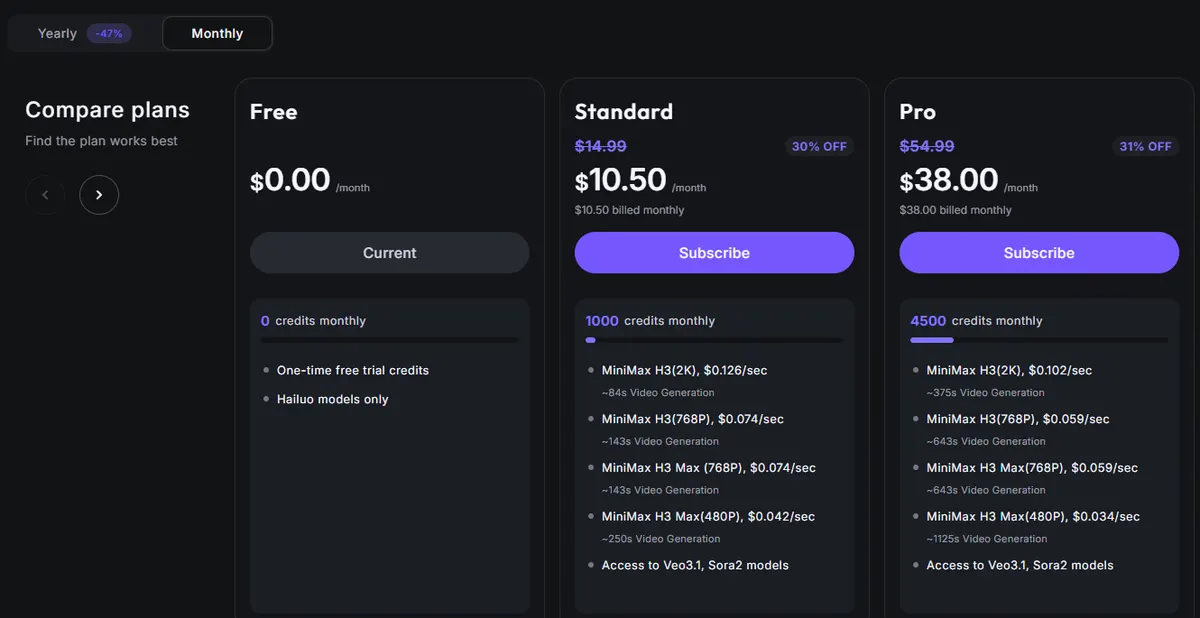
Best for: 2K clips with the per-second price shown up frontHailuo is MiniMax's video app. Its current model, MiniMax H3, generates video with native stereo sound, up to 15 seconds at 2K, according to MiniMax. It takes images, video and audio as references, so you can set the product image as the start frame. Hailuo also offers Wan 3.0.
- Pricing: Standard is $10.50 a month on monthly billing (discounted from $14.99), or $8.40 a month billed yearly, with 1,000 credits. Hailuo's plan picker puts that at about 84 seconds of H3 at 2K ($0.126 per second) or 143 seconds at 768p ($0.074 per second) on monthly billing.
- Free: one-time trial credits for Hailuo models.
Strengths
- 2K output and clips up to 15 seconds, with stereo sound
- The price per second is printed on the plan
- Takes image, video and audio references in one prompt
Limits
- Standard's credits cover under 90 seconds of 2K video a month
- Free credits are one-time, not monthly
- A general creative app, with no product ad workflow
Pick this instead of CamClo AI if you want 2K clips with sound at a clear per-second price and are happy to write every prompt.
7. Adobe Firefly
Best for: a commercially safe video modelFirefly is Adobe's generative AI app. Its Image to Video tool animates an uploaded photo with camera controls for zoom, pan and tilt, and exports MP4 up to 4K, in clips of about five seconds depending on the model. You can use the Firefly Video Model or partner models from Google, Runway, Luma and others. Adobe says its Firefly models are trained only on licensed and public domain content.
- Pricing: Adobe's plan page shows prices for the visitor's region, so for US dollar prices see vendor site. Firefly Standard includes 2,000 credits a month and up to 20 five-second videos; Firefly Pro 4,000 credits and up to 40.
- Free: free daily generations with an Adobe account.
Strengths
- A clear commercial-use statement for Firefly-model output
- Up to 4K and simple camera controls
- Fits teams already working in Adobe apps
Limits
- Clips of about five seconds
- Video counts are capped by plan, and video generation uses credits
- No product ad formats or scripts
Pick this instead of CamClo AI if your team lives in Adobe apps and wants Adobe's commercial-use terms around its own model.
8. Pika
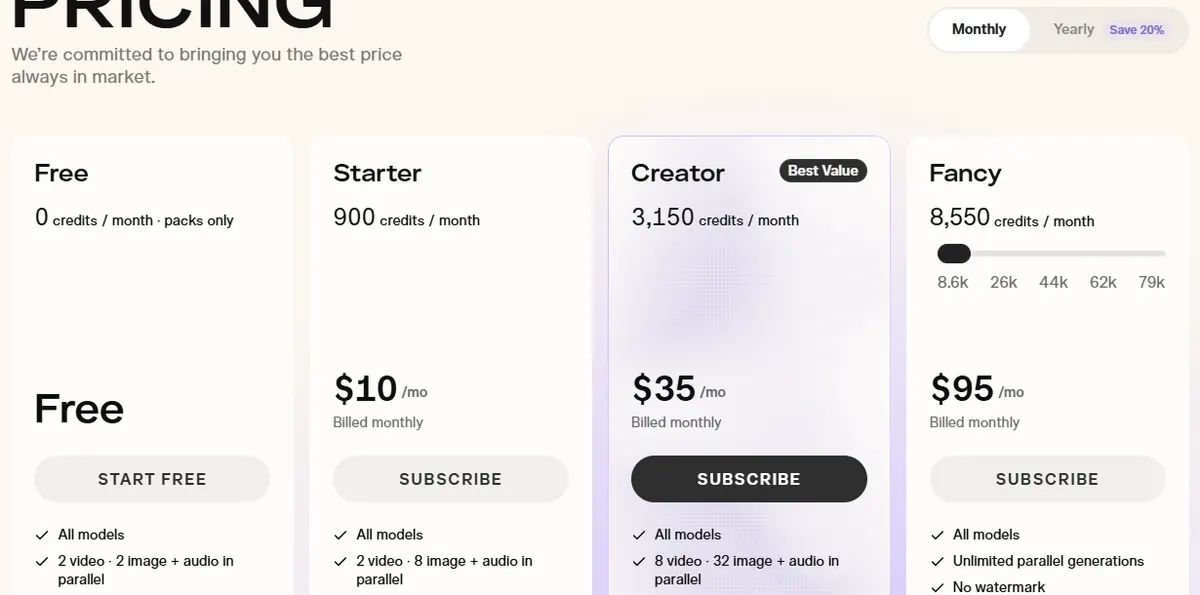
Best for: trying many video models in one appPika has become a multi-model studio. One plan covers Pika 2.5 alongside Seedance 2.5, MiniMax H3, Gemini Omni Flash and Wan 3.0. Its Video Studio makes anything from a short clip to a 30-second multi-shot video, and separate tools extend a clip, score it with music and sound, or make product shots.
- Pricing: Starter is $10 a month with 900 credits, but no commercial license. Creator is $35 a month with 3,150 credits and a commercial license. A 5-second Seedance 2.5 clip at 720p costs 122 credits; a 5-second Wan 3.0 clip costs 33.
- Free: a Free plan with no monthly credits; you buy credit packs.
Strengths
- Several leading models behind one login
- Up to 30-second multi-shot videos
- Built-in tools to extend and score clips
Limits
- Ads for your business need the $35 Creator plan for a commercial license
- The Free plan has no monthly credits
- No product ad formats or scripts
Pick this instead of CamClo AI if you want to compare several general video models side by side and will build the ads yourself.
9. Creatify
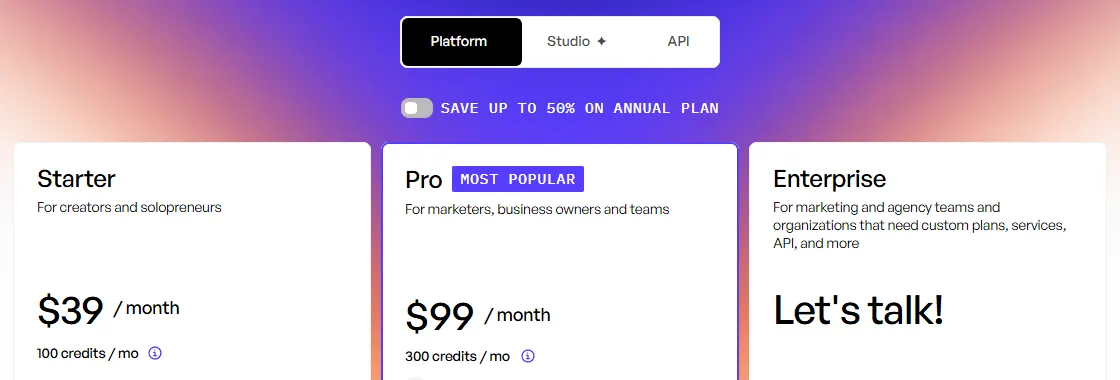
Best for: turning a product link into video adsCreatify is an AI ad platform. Paste a product URL, or upload a single product image, and it builds video ads, from product shots to UGC-style videos with an AI actor. Its product-video page says videos start from $2 each.
- Pricing: Starter is $39 a month with 100 credits, 300 AI actors, 50+ premium models, 75+ languages and videos up to 2 minutes. Pro is $99 a month with 300 credits. Yearly billing saves up to 50%.
- Free: 10 credits a month, with a watermark on exports.
Strengths
- Starts from a product link, with no script needed
- AI actors speaking 75+ languages
- A free plan to test with
Limits
- One generation at a time on Starter
- The free plan's 10 credits make up to 2 video ads, with a watermark
Pick this instead of CamClo AI if you would rather start from a product page URL than a photo, or you want an AI actor presenting in many languages.
10. Canva
Best for: free, quick clips inside a designCanva's Image to Video tool sits in Magic Studio. Pick Smart for automatic motion or Custom to describe it, and Canva turns the image into a three-second video that you can edit with text, music and effects, then resize for other platforms with Magic Resize.
- Pricing: Canva's pricing page showed only regional prices from where we checked, so see vendor site. Image to Video itself is free.
- Free: available on Canva Free, Pro, Teams, Enterprise and Nonprofits.
Strengths
- Free on every plan
- Inside the editor you may already use for social posts
- No prompt needed with Smart mode
Limits
- Three-second clips
- Little control over the motion
- Canva says you may not have exclusive rights to AI output
Pick this instead of CamClo AI if you only need a moving image inside a Canva design and want it free.
How we compared them
We started from the tools that appear in Google's top results and in the ranking roundups for this search, then read each vendor's official pricing, product and help pages and saved screenshots of the pricing pages we could reach in US dollars. Google's AI plans, Adobe and Canva showed only regional prices from where we checked, so their plan prices say "see vendor site".
We judged each tool on the five things that matter most for product and fashion videos: whether it starts from your photo and keeps the product's details (reference images, end frames), whether it outputs vertical video, how long a clip can run, whether it generates sound, and what a second of video costs on the entry plan. We did not run a scored benchmark, so there are no quality scores here. Test your own product before you commit.
Since our last update, we removed tools that no longer show up for this search or that do something else. If you want a person on camera presenting your product, our guide to HeyGen alternatives for UGC video ads compares avatar and AI actor tools. If you used Sora, which OpenAI closed in 2026 (the app on April 26 and the API on September 24), see our Sora alternatives for product videos.
How to choose an image to video tool for products
- Start from your sharpest product photo. Text-only prompts invent details. If the tool takes reference images, add a second or third angle of the product.
- Check the details frame by frame. Prints, logos, stitching and labels are where video models slip. Regenerate or add a reference image when a detail changes.
- Match the format to the channel. Reels, TikTok and Shorts want 9:16. Feeds often want 4:5 or 1:1, and product pages 1:1 or 16:9.
- Decide if you need sound. Some tools charge less for silent clips, and some models cannot make sound at all, so check whether audio is included in the price.
- Price the second, not the plan. Work out how many seconds of video you need each month, then compare using the table above, with room for retakes.
- For clothing, show the fit. A garment moving on a person shows fit and drape that a flat lay cannot. See our comparison of virtual try-on tools for clothes, or try AI virtual try-on before you animate the result.
Comparing on price? Our image to video AI pricing guide works out what a clip costs on 12 tools.
Frequently asked questions
What is the best AI image to video tool?
It depends on the job. For product videos and video ads made from a product photo, CamClo AI is built for it, with several video models, vertical formats and ad formats in one place. For the lowest price per second at 720p with sound, Veo 3.1 Lite costs $0.05 per second of 720p video on Google's Gemini API. For directing camera moves shot by shot, pick Runway, and for free three-second clips inside a design, Canva works.
How do image to video AI prices compare?
Per second of video: Veo 3.1 Lite on the Gemini API cost $0.05 at 720p with sound, Luma's Ray3.2 about $0.06 at 720p without sound on the $30 Plus plan, Hailuo's MiniMax H3 $0.074 at 768p on its $10.50 Standard plan, Kling 3.0 on its API $0.126 at 720p with sound, Pika about $0.27 for Seedance 2.5 at 720p on the $10 Starter plan, and Runway about $0.29 for Gen-4.5 on the $15 Standard plan. On CamClo AI's $49 plan, a second costs about $0.13 on Kling 2.5 Turbo, $0.16 on Veo 3.1 Lite with sound and $0.42 on Seedance 2.0 at 720p.
Can AI turn product photos into videos?
Yes. Upload a sharp product photo, describe the motion you want, such as a slow turn, a hand picking it up or a model walking, and the tool generates a short clip. Tools that take extra reference images or an end frame give the model more of the real product to follow. Check prints, logos and labels frame by frame before you publish.
Can I use AI image to video for commercial purposes?
Usually, but check the plan. Pika's commercial license starts on its $35 Creator plan, Kling lists commercial use on its paid plans, and Luma lists it from its $30 Plus plan. Adobe says video made from an image with its Firefly models is commercially safe as long as the image you upload does not break anyone else's rights. Canva allows commercial use under its AI terms but says you may not have exclusive rights to the output.
Which image to video AI is easiest for beginners?
Canva is the simplest start: choose Image to Video in Magic Studio and pick Smart for automatic motion, with no prompt needed. Adobe Firefly has free daily generations and simple camera controls. For product videos, CamClo AI starts from your product photo and offers ready-made video ad formats that write the script for you, so no animation or editing skills are needed.
Is there a free AI image to video tool?
Yes, with limits. Canva's image to video is free on every plan, Adobe Firefly has free daily generations, Runway gives 125 one-time credits, and Kling has a free Basic plan without monthly credits. CamClo AI has a 7-day trial for $1 with 20 credits.
How long can an AI image to video clip be?
Most current models top out at 8 to 15 seconds per generation. Seedance 2.5 reaches 30 seconds in CamClo AI, MiniMax H3 and Kling 3.0 reach 15 seconds, Runway's Gen-4.5 10 seconds and Veo 3.1 8 seconds, which Veo can extend to 148 seconds at 720p. Canva's image to video makes three-second clips, and Adobe Firefly clips run about five seconds.
Turn your product photos into videos and ads
Start a 7-day trial for $1 with 20 credits.
See plans and the $1 trial