
Table of Contents
Introduction
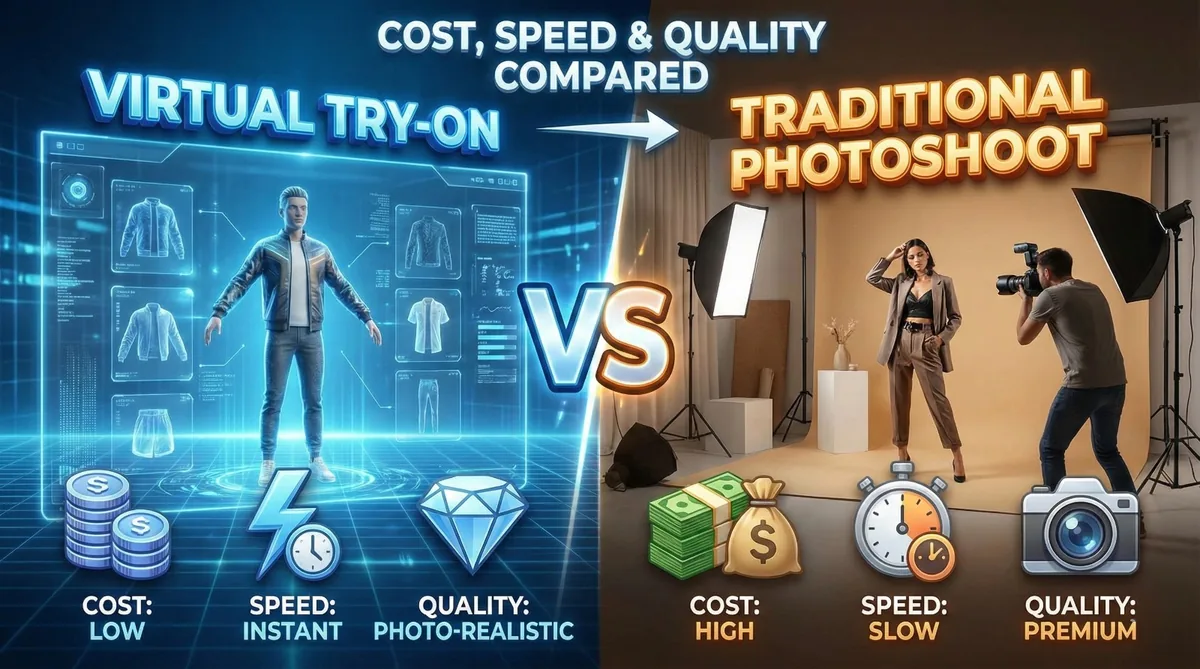
Virtual try-on is changing how US fashion brands create product content — not over years, but right now. Brands that once spent thousands on a single photoshoot produce the same output in hours at a fraction of the price.
This article compares virtual try-on directly against traditional photoshoots across three areas: cost, speed, and quality. We also break down the main AI virtual try-on tools available to US sellers in 2026, so you can see where each one fits.
If your business produces fashion content at scale — for an online store, social media, or a product catalog — this comparison gives you a clear picture of where your money and time are best spent.
Key Takeaway
- Cost: Virtual try-on cuts per-garment content cost from $250 to $3 — a 98% reduction
- Speed: Output in minutes vs 2-3 weeks for traditional photoshoots
- Quality: AI-generated images match mid-range shoots; video output adds motion that most brands skip entirely due to traditional production costs
- Best approach: Use virtual try-on for day-to-day content; reserve traditional shoots for campaign-level creative
What a Traditional Photoshoot Actually Costs
A traditional photoshoot involves multiple moving parts. Each one adds time and money.
Studio rental in major US cities like New York or Los Angeles runs between $150 and $500 per hour. A full-day rental with lighting equipment costs $1,500 to $4,000.
Model fees vary by experience. A mid-tier model through a US agency charges $150 to $500 per hour. Booking a model for a full day means $1,200 to $4,000 before agency commission.
Photography and editing add another layer. A commercial fashion photographer in the US charges $200 to $600 per hour. Add 8 to 10 hours of post-production editing, and the cost grows fast.
Styling, makeup, and wardrobe round it out. A fashion stylist charges $100 to $300 per hour. A makeup artist runs another $100 to $250.
| Line Item | Estimated Cost |
|---|---|
| Studio rental (full day) | $2,000 |
| Model (full day) | $2,500 |
| Photographer + editing | $2,000 |
| Stylist + makeup | $1,000 |
| Total | $7,500 |
That is $7,500 to photograph one collection. If that collection has 30 garments, the cost per garment is $250. For a small brand launching new products every month, this adds up to $90,000 per year — just for product photos.
Video content adds more. A product video shoot for a short 30-second clip requires extra equipment, a director, a separate edit, and more model time. The average production cost for a fashion video in the US runs $5,000 to $25,000, depending on scope.
The Scaling Problem
This model works, but it does not scale. Brands that need to launch new products weekly, react to trends, or produce content for multiple platforms hit a ceiling fast — not because of creative limits, but because of budget and turnaround time.
What Virtual Try-On Actually Costs
Virtual try-on removes most of those line items. There is no studio. There is no model booking. There is no stylist, makeup artist, or photographer. Upload a model photo and a garment photo. The AI handles the rest and returns a try-on image.
From that image, some platforms let you take an additional step and generate a short video — but the core try-on output across all tools is an image.
| Tool | Free Tier | Paid Plan (Starting) | Try-On Output | Video Generation |
|---|---|---|---|---|
| Camclo | Available | $29/month | Image + Video | ✓ Yes (Kling, Veo3) |
| FASHN.ai | 10 free credits | $19/month | Image + Video | ✓ Yes |
| SellerPic AI | 20 free credits | $29/month | Image + Video | ✓ Yes |
| Kling AI | Limited credits | $10/month | Image + Video | ✓ Yes |
| Kolors Virtual | Free, rate-limited | $9.99/month | Image only | ✗ No |
| Pic Copilot | Free tier | $14.99/month | Image + Video | ✓ Yes |
The Math
The cost per garment using these tools falls to $1 to $10, depending on the platform and output volume. At $3 per output, a 30-garment collection costs around $90 versus $7,500 for a traditional shoot. That is a cost reduction of over 98%.
Speed: Hours vs Weeks
A traditional photoshoot requires lead time. Book the studio, confirm the model, arrange garment shipping, coordinate the photographer, and prep the set. That process takes one to two weeks at a minimum before a single photo gets taken.
The shoot day runs 8 to 10 hours. Post-production editing takes another 3 to 7 business days. From brief to final delivery, a typical fashion photoshoot takes 2 to 3 weeks.
Virtual try-on compresses that timeline to hours. Upload two photos. The AI returns a try-on image in seconds to a few minutes. If you then want a short video showing the garment in motion, platforms like Camclo let you take that image into a separate video generation step — the full image-to-video workflow still completes in minutes, not weeks.
| Step | Traditional Photoshoot | Virtual Try-On |
|---|---|---|
| Setup and booking | 1–2 weeks | None |
| Shoot day | 8–10 hours | None |
| Post-production | 3–7 days | None |
| Output ready | 2–3 weeks | Minutes |
For brands that launch new products weekly, drop limited collections, or react to seasonal trends, this speed difference is the deciding factor. A US brand that spots a trending silhouette on Monday has product content live on its site by Tuesday — without a single call to an agency.
Quality: What AI Produces vs What a Camera Captures
Quality is not one thing. It is a combination of several factors: resolution, garment detail, body realism, and motion.
Still Image Quality
Modern AI virtual try-on tools produce high-resolution still images that hold up in product listings. Logos, prints, fabric texture, and stitch patterns render accurately across modern tools.
For straightforward garments like T-shirts, jeans, and simple dresses, AI-generated try-on images now match what a mid-range photoshoot produces. For complex items — heavily embellished dresses, structured blazers, or garments with unusual silhouettes — output quality varies by tool and the quality of inputs.
Video Quality
This is where AI-powered workflows pull ahead of most traditional production methods — but it is worth being specific about how it works.
Virtual try-on generates a still image of the garment on the person. From that image, some platforms offer a second step: video generation. This converts the try-on image into a short clip showing the garment in motion. Camclo does this by passing the try-on image through Kling, developed by Kuaishou, or Veo3, developed by Google DeepMind — two of the most capable video generation models available in 2026. The output shows the fabric falling, flowing, and responding to movement under natural lighting.
Most small and mid-sized US fashion brands skip regular product video entirely because traditional video production — a director, lighting rigs, multiple takes, a separate edit — costs $5,000 to $25,000 per clip. The AI image-to-video workflow brings that same type of output down to a few dollars and a few minutes.
See how Camclo generates virtual try-on content — from garment upload to video output
Video Drives Results
Video content performs better on social platforms. TikTok, Instagram Reels, and YouTube Shorts all favor video in their feed rankings. Ecommerce product pages with video convert up to 80% better than those without (Invesp), and social videos are shared 1,200% more than text and image content combined (Sprout Social).
Body Diversity
Traditional photoshoots are limited by the models you book. Showing a garment on a size XS body and a size 2XL body means booking two separate models, two separate shoot sessions, and doubling the production cost.
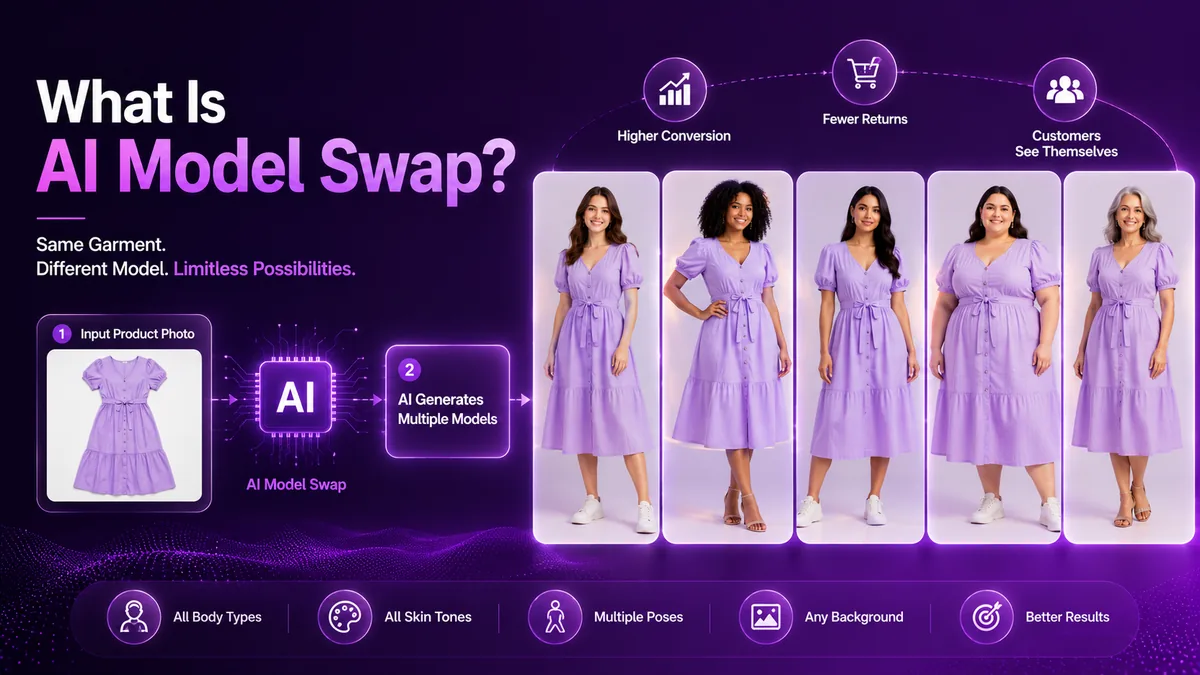
AI try-on tools handle this differently. Most tools include a model library with options across gender, age, skin tone, and body size. For US e-commerce brands that serve diverse customers, showing garments across a range of body types is both a commercial advantage and an increasingly expected standard.
Tool Breakdown: Virtual Try-On Options in 2026
Not all virtual try-on tools work the same way. Here is a direct look at the tools US sellers use most.
Camclo
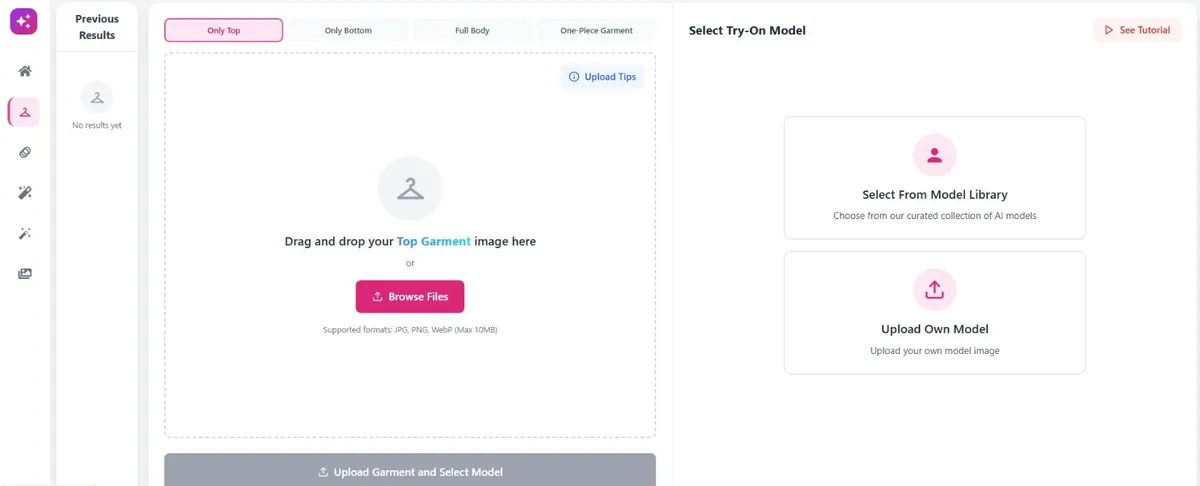
Camclo's virtual try-on produces a still image of the garment on the chosen person. From that image, users can take an additional step and generate a short video clip using one of two video generation models: Kling, built by Kuaishou, or Veo3, built by Google DeepMind.
The workflow is direct. Upload a model photo or choose one from the built-in library. Upload a garment photo. The platform generates the try-on image. From there, select Kling or Veo3 to generate a video showing the garment in motion. Camclo is a focused fashion tool — not a general-purpose AI platform with try-on added as a side feature.
⚡ Strengths
- Video output via Kling and Veo3 — two best-in-class generation models
- Built specifically for fashion content production
- Effective across dresses, outerwear, and activewear
- Strong for social media marketing where video drives engagement
- No production budget or studio space needed
⚠ Weaknesses
- Video generation takes longer than instant image output
- Newer platform compared to established tools
FASHN.ai
FASHN.ai builds and trains its own AI model for fashion try-on — it does not repurpose a general image model. Output quality is solid, with accurate garment detail across logos, prints, and textures.
The Consistent Models feature keeps the same AI model identity across a full product catalog. This matters for brands that want visual consistency across product pages without booking a model for every shoot.
New users get 10 free image credits on signup with no credit card required. Paid plans start at $19 per month. FASHN.ai targets professional developers and larger fashion brands and is not built for small sellers who want a no-code workflow.
⚡ Strengths
- Proprietary AI model trained specifically on fashion data
- Consistent Models: same model identity across your full catalog
- API with Python and TypeScript SDKs
- In-app and API video generation
- Strong garment detail preservation
⚠ Weaknesses
- Free tier limited to 10 credits
- Skews toward professional/developer use
- Less accessible for small sellers wanting a no-code workflow
SellerPic AI
SellerPic AI is an e-commerce image platform with virtual try-on built in. Its standout feature is accessories support — jewelry, watches, earrings, and handbags. Most other tools on this list handle clothing only.
⚡ Strengths
- 20 free credits — low barrier to testing
- Accessories coverage: jewelry, watches, earrings, handbags
- Fast generation for high-volume product listings
⚠ Weaknesses
- Try-on is one feature in a broad suite, not fashion-dedicated
- Complex garment output trails behind specialized tools
Kling AI
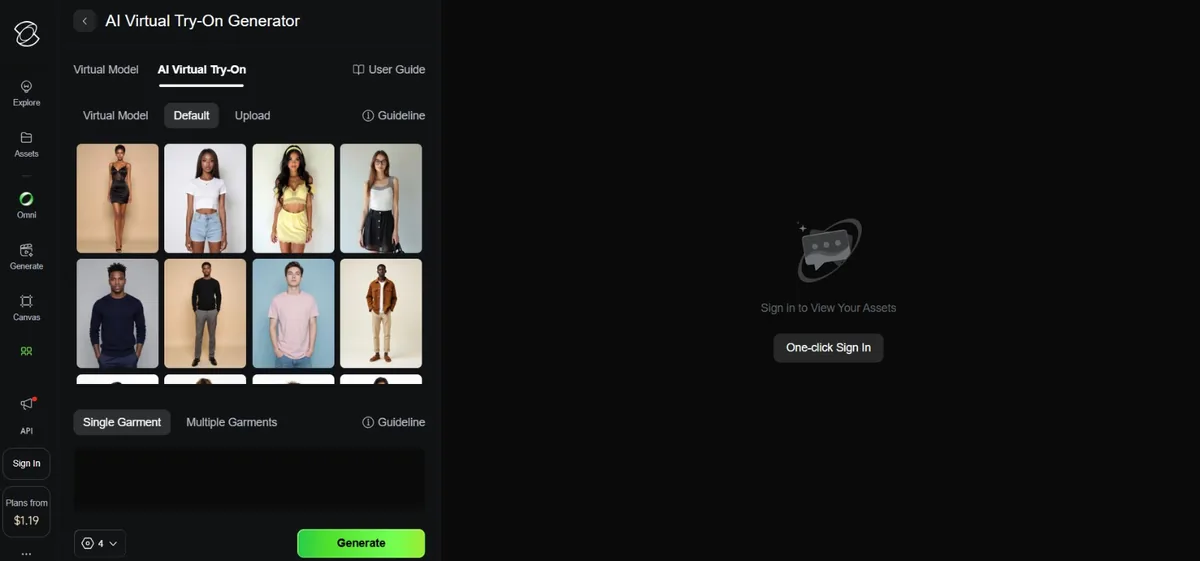
Kling AI is a broad AI creative platform built by Kuaishou. Its virtual try-on feature generates still images using the Kolors 2.1 model, with video generation available as a separate step. The platform supports single and multi-garment try-ons and includes a pre-built model library.
⚡ Strengths
- Both images and videos from a single platform
- Single and multi-garment try-ons
- Pre-built model library with diverse options
- API available for developer integrations
⚠ Weaknesses
- Free credits deplete quickly under regular use
- General-purpose platform — not fashion-focused
Kolors Virtual
Kolors Virtual started as an open-source project on Hugging Face from Kwai-Kolors, Kuaishou's research team. A standalone paid platform now exists. The free version on Hugging Face requires no signup — useful for testing output quality before committing to a paid plan.
⚡ Strengths
- Free entry point via Hugging Face — no sign-up needed
- Simple three-step workflow
- Supports both image and video output
⚠ Weaknesses
- Free version is rate-limited, not production-ready
- No API on the standalone platform
Pic Copilot
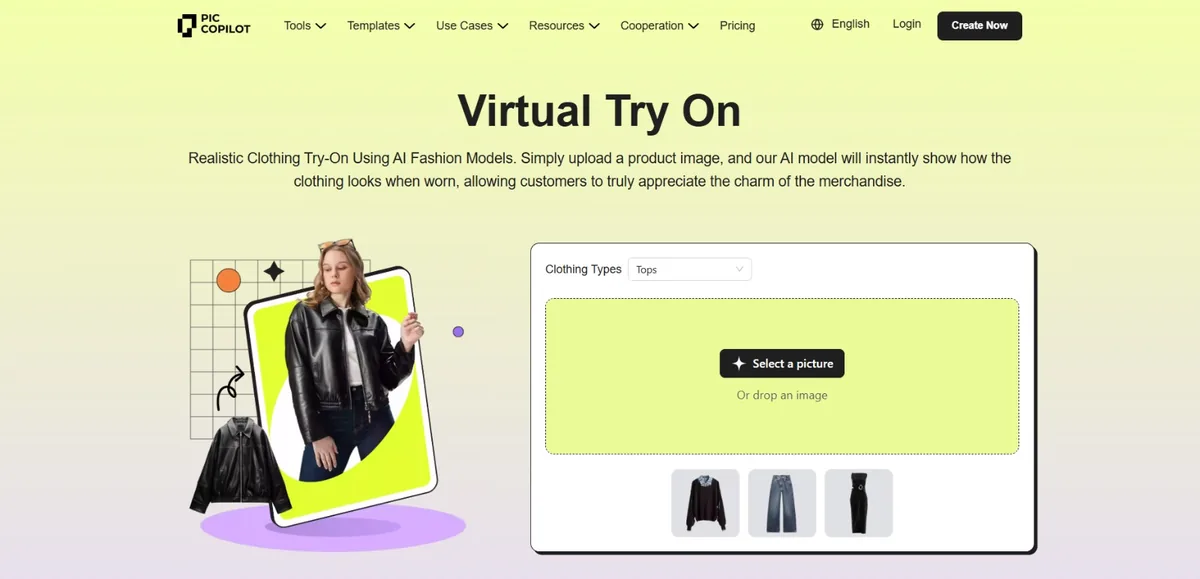
Pic Copilot is a simple try-on tool for marketplace sellers. Upload a model image and a clothing item. The output — a still image — is ready in seconds.
⚡ Strengths
- Fast generation — results in seconds
- Simple interface with minimal setup
- Free tier available
⚠ Weaknesses
- Image-only output — no video generation
- Less control over model selection and scene composition
When Virtual Try-On Makes Sense — and When It Does Not
Virtual Try-On Fits Well
- High product volume — brands launching 20+ new items per month
- Social media content — video for TikTok, Instagram Reels, YouTube Shorts
- Product testing — early visuals before investing in a full photoshoot
- Body diversity — garments across multiple sizes and skin tones
- Speed to market — content live within hours, not weeks
Traditional Photoshoots Still Win
- High-fashion editorials — where art direction is part of the brand identity
- Hero campaign shots — billboards, large-format advertising, physical retail
- Tactile products — premium leather goods, heavily structured tailoring where texture drives the purchase decision
For most US e-commerce brands and content creators, day-to-day production work fits the virtual try-on workflow. Traditional shoots serve specific high-investment moments.
The Practical Decision for US Sellers
The comparison comes down to this: traditional photoshoots deliver a known, controlled result, but at high cost and slow turnaround. Virtual try-on delivers fast, scalable image output at a fraction of the price — and for brands that need video, the additional image-to-video step opens a production type that most small and mid-sized brands could not afford through traditional means.
US fashion sellers who produce regular product content — listings, social posts, and catalog updates — will find that virtual try-on handles the bulk of that work at a cost and speed that traditional shoots cannot match.
The best approach for most brands is not either/or. Use AI try-on tools for day-to-day product content, high-volume catalog work, and social video. Reserve traditional photoshoot budgets for campaign-level creative where the production quality is part of the brand message itself.
Related Reading
Want to go deeper? These articles cover related topics for US fashion sellers:
- Virtual Try On for Clothes: Best AI Tools Compared 2026 — a full tool-by-tool breakdown with feature comparisons
- How AI Virtual Try-On Reduces Returns for US Apparel Stores — the return rate data and ROI case for virtual try-on
Ready to Try Virtual Try-On?
See the difference for yourself. Upload a garment and generate your first try-on image in minutes.
Try Camclo Now