

Table of Contents
For 500 products, bulk AI image generation cost with video comes to approximately US$1,569 in generation charges for 1,500 approved Nano Banana 2 1K images and 500 approved ten-second Seedance 2.5 720p clips. Assume 80% acceptance for both images and video. This uses Google's image-output pricing of US$0.067 per 1K image and a video rate of US$0.231/second, based on BytePlus's US$1.156 five-second 720p, 16:9 example without video input. Preparation and review bring the subtotal to US$2,694 before finishing, infrastructure, additional input charges and taxes.
For a browser workflow, our AI Assistant shows the proposed workflow and credit cost before execution. Approving the proposal authorizes production spending; publication approval comes after you review the outputs.
What does it cost to generate AI images and videos in bulk for a 500-product ecommerce catalogue?
Budget approximately US$2,694 for generation, preparation and review of three approved images and one approved ten-second clip per product. The final catalogue price also depends on finishing, infrastructure, additional input charges and taxes.
Worked example: three images and one clip per product
The scope includes one delivered version of each view and clip. At 80% acceptance, allow for the following generation attempts.
| Deliverable | Scope calculation | Approved requirement | Expected attempts |
|---|---|---|---|
| Images | 500 × 3 views × 1 version | 1,500 images | 1,500 ÷ 80% = 1,875 |
| Videos | 500 × 1 clip × 1 version | 500 clips | 500 ÷ 80% = 625 |
| Video duration | 500 × 10 seconds | 5,000 seconds | 625 × 10 = 6,250 seconds |
Multiply products by views and delivered versions for images. For video, multiply products receiving video by clips and versions, then by duration. A generated variation is another output; a simple crop or export of an approved asset does not automatically require regeneration.
Nano Banana 2 and Seedance 2.5: API rates versus browser packages
Raw API output charges
The image budget uses product-reference input with Nano Banana 2. Google bills image output alongside input and applicable text or thinking charges.
| Model | Resolution | Standard, US cents/image | Batch, US cents/image |
|---|---|---|---|
| Nano Banana 2 | 1K | 6.7 | 3.4 |
| Nano Banana 2 | 2K | 10.1 | 5.0 |
| Nano Banana 2 | 4K | 15.1 | 7.6 |
| Nano Banana 2.1 | 1K | 3.4 | 1.7 |
Nano Banana 2.1 has its own pricing. The catalogue budgets below use Nano Banana 2.
| Nano Banana 2 1K method | 1 output, US$ | 100 outputs, US$ | 500 outputs, US$ |
|---|---|---|---|
| Standard | 0.067 | 6.70 | 33.50 |
| Batch | 0.034 | 3.40 | 17.00 |
Google's Batch API runs asynchronously at 50% of Standard cost, targeting completion within 24 hours.
BytePlus's Seedance 2.5 image-to-video example uses 720p, 16:9 and no video input. Its five-second price gives a rate of approximately US$0.231/second, which is used here for ten-second clips. Actual charges follow the provider's billing rules.
Subscriptions, packs and minimum cash spend
Common published browser packages offer the following allowances. For a job requiring 100 images, compare the cash due with the capacity left unused.
| Billing | Cash due, US$ | Image allowance | Full-use rate, US cents/image | Unused at 100 images |
|---|---|---|---|---|
| Monthly | 9 | 200 credits/images | 4.5 | 200 − 100 = 100 |
| Monthly | 19 | 500 credits/images | 3.8 | 500 − 100 = 400 |
| Monthly | 49 | 1,500 credits/images | 3.3 | 1,500 − 100 = 1,400 |
| Monthly | 99 | 4,000 credits/images | 2.5 | 4,000 − 100 = 3,900 |
| One-time pack | 5 | 100 images | 5.0 | 100 − 100 = 0 |
| One-time pack | 15 | 100 images | 15.0 | 100 − 100 = 0 |
| One-time pack | 50 | 500 images | 10.0 | 500 − 100 = 400 |
The monthly examples convert one credit into one image, but conversion depends on the tool. Compare top-up availability, expiry, rollover, commercial rights and generation settings separately. An annual commitment requires the annual invoice amount, not merely its advertised monthly equivalent.
API prices exclude integration, storage and operating effort. Local generation also needs hardware, electricity and staff time.
Build an approved-catalogue budget
Inputs and vendor rates
Start with the deliverable scope, then record each provider, exact model, resolution, input mode, currency, output rate and additional input charges. For labor, assume two preparation minutes per product, 30 review seconds per attempt and US$30/hour.
Adjust the hourly rate for your country and team. For context, the U.S. Bureau of Labor Statistics reports a May 2025 graphic-designer median of approximately US$30.3/hour; wages alone exclude fully loaded agency costs.
- Expected attempts: required approved outputs ÷ acceptance rate, rounded upward for each medium.
- Retries: expected attempts − required approved outputs.
- Preparation: products × minutes ÷ 60 × hourly cost.
- Review: generated attempts × review seconds ÷ 3,600 × hourly cost.
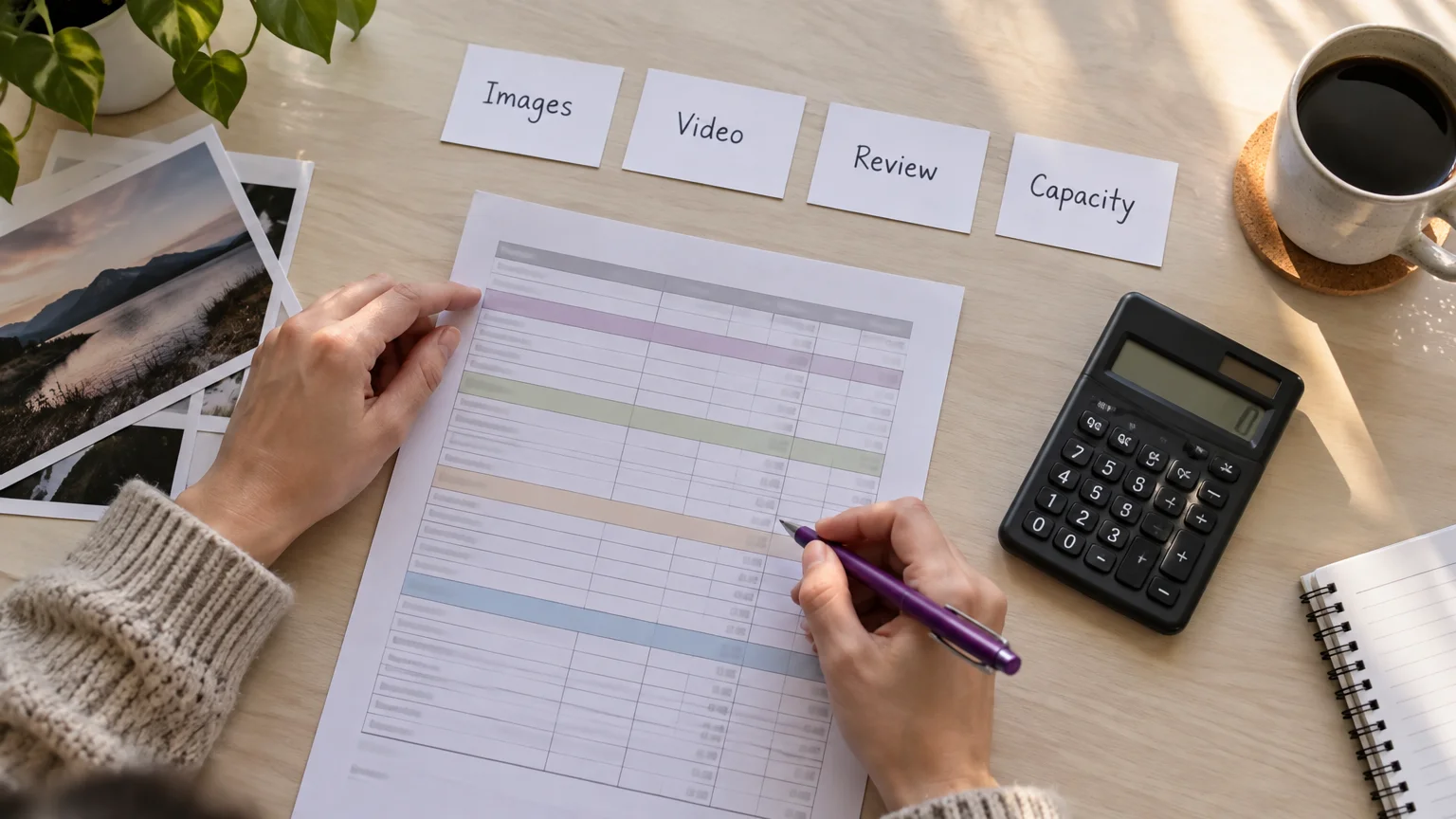
Deliverable budget and purchasing capacity: core example
| Budget line | Calculation or allowance | US$ |
|---|---|---|
| Source preparation | 500 × 2 ÷ 60 × 30 | 500 |
| Base image generation | 1,500 × 0.067 | 101 |
| Base video generation | 500 × 10 × 0.231 | 1,155 |
| Image retries | 375 × 0.067 | 25 |
| Video retries | 125 × 10 × 0.231 | 289 |
| Review labor | 2,500 × 30 ÷ 3,600 × 30 | 625 |
| Subscription capacity | API route | 0 |
| Optional finishing | Retouching, upscaling, ad assembly | Additional allowance |
| Infrastructure and inputs | Integration, storage, applicable tokens | Additional allowance |
| Taxes | Applicable invoice treatment | Additional allowance |
Generation totals approximately US$1,569. Preparation and review add US$1,125, bringing the subtotal to US$2,694.
Charge retries once. Rejection-adjusted attempts already include them, so do not add another retry allowance to those generation charges.
For browser purchasing, credit shortfall equals the quoted requirement minus eligible available credits, with a minimum of zero. Divide that shortfall by the pack size and round upward. Cash required is the subscription commitment plus purchased top-ups and applicable charges. The subscription invoice already covers its included credits.
How much does bulk AI image generation cost per approved image?
The core example costs 8.4 US cents per approved image for generation alone. Assigning image review and 75% of shared preparation to images raises the image-specific cost to 64.6 US cents per approved image. Calculate video costs separately; dividing the entire mixed-media budget by image count misstates image economics.
How do acceptance rates and retries change the total AI production budget?
At 80% acceptance, the core scope needs 375 image retries and 125 video retries. Enter image acceptance and video acceptance independently because publication failure rates can differ.
Lean, core and expanded deliverables
Compare three scopes using the same rates and labor inputs. Change either acceptance rate to reprice the work.
| Scenario | Approved images; attempts | Approved clips; attempts | Image acceptance | Video acceptance |
|---|---|---|---|---|
| Lean | 500; 500 ÷ 80% = 625 | 100 × 5 seconds; 100 ÷ 80% = 125 | 80% | 80% |
| Core | 1,500; 1,500 ÷ 80% = 1,875 | 500 × 10 seconds; 500 ÷ 80% = 625 | 80% | 80% |
| Expanded | 2,500; 2,500 ÷ 80% = 3,125 | 1,000 × 10 seconds; 1,000 ÷ 80% = 1,250 | 80% | 80% |
Lean generation costs approximately US$186 for 625 image attempts and 125 five-second video attempts. Expanded generation costs approximately US$3,097 for 3,125 image attempts and 1,250 ten-second video attempts.
| Scenario | Generation, US$ | Preparation, US$ | Review, US$ | Subtotal, US$ |
|---|---|---|---|---|
| Lean | 186 | 500 | 750 × 30 ÷ 3,600 × 30 ≈ 188 | 186 + 500 + 188 = 874 |
| Core | 1,569 | 500 | 625 | 2,694 |
| Expanded | 3,097 | 500 | 4,375 × 30 ÷ 3,600 × 30 ≈ 1,094 | 3,097 + 500 + 1,094 = 4,691 |
Review covers every attempt, not just the approved assets: 750 attempts for lean, 2,500 for core and 4,375 for expanded. Subtotals include generation, preparation and review; finishing, infrastructure, additional input charges and taxes remain separate.
Acceptance sensitivity and approval checks
For the core scope, image acceptance of 60%, 80% or 95% requires 2,500, 1,875 or 1,579 attempts. Video acceptance at those rates requires 834, 625 or 527 attempts. The matrix shows generation charges only, in US dollars.
| Image acceptance | Video 60% | Video 80% | Video 95% |
|---|---|---|---|
| 60% | 2,094 | 1,611 | 1,385 |
| 80% | 2,052 | 1,569 | 1,343 |
| 95% | 2,032 | 1,550 | 1,323 |
An approved asset must pass product-identity, geometry, garment-detail, color, pattern, material and consistency checks. Video must also preserve the product throughout motion. Google Merchant Center's image requirements require imagery to match the sold variant and accurately reflect its color, pattern, finish and material.
A technically successful generation can still fail publication review. Test representative products, measure both acceptance rates and revise the budget before committing the catalogue.
How do I convert our credits into a realistic catalogue budget?
Use our Assistant's proposed workflow cost and your eligible credit capacity. Our dedicated Nano Banana 2 Smart Edit outputs use one credit at 1K/2K and two at 4K; our Seedance 2.5 pricing lists 16.5 credits for ten seconds at 720p.
At those dedicated-tool rates, the core scope requires 1,875 × 1 credit + 625 × 16.5 credits = 12,187.5 credits. For an Assistant workflow, use the cost shown in its proposal.
Fast chat is free, Quality chat consumes credits per message, and approved generations have separate costs. Changing proposal settings reprices the card, so review the updated cost before approving.
Our entry plan is US$49/month for 150 credits, and our Studio plan is US$999/month for 5,000 credits. The Studio plan's included capacity is below the core scope's 12,187.5-credit requirement at dedicated-tool rates. We also offer a seven-day US$1 trial with 20 credits through our AI Assistant.
Our AI Assistant offers catalogue workflows for up to 500 products. Match the proposed workflow's credit requirement to the capacity you purchase.
Frequently asked questions
Does Higgsfield pricing offer the same model settings and usable capacity as this catalogue budget?
Compare the package's eligible capacity and model settings with the core scope: 1,875 Nano Banana 2 1K image attempts and 625 ten-second Seedance 2.5 720p video attempts. A headline credit allowance is not the same as a count of approved deliverables.
Can free image-to-video credits cover a commercial 500-product job?
Only if their eligible capacity and commercial-use terms cover the entire video scope. The core example requires 625 ten-second video attempts to deliver 500 approved clips at 80% acceptance. Video credits do not cover source preparation, image production or review labor.
Does a bulk-generation subscription include enough capacity for the whole catalogue?
Only when its eligible credits meet the proposed workflow requirement. Our Studio plan includes 5,000 credits for US$999/month, below the core example's 12,187.5-credit requirement at dedicated-tool rates. Use the Assistant's pre-execution proposal to establish the workflow requirement before purchasing capacity.
What source-preparation and review costs should an agency include in its quote?
The core example includes US$500 for source preparation and US$625 for review. Preparation assumes two minutes for each of 500 products at US$30/hour; review assumes 30 seconds for each of 2,500 generated attempts at the same hourly rate. Add finishing, infrastructure, additional input charges and applicable taxes to complete the production budget.
Choose the workflow and request an accurate quote
Choose the route with the lowest complete cost for approved assets delivered by your deadline.
- Asynchronous API: suits teams with integration capacity and flexible turnaround.
- Browser workflow: suits teams prioritizing orchestration and reduced setup.
- Local generation: evaluate hardware, support, quality and labor alongside electricity.
Your agency quote should state approved deliverables, revision boundaries, production cost, contingency, chosen margin and taxes. Compare commercial rights, capacity, concurrency and delivery requirements. Use our current pricing for purchasing terms and the bulk catalogue tutorial for execution guidance.
Start with a scoped deliverable list, then request a pre-execution proposal through our AI Assistant.